
Justice Stephen Breyer is a retired Associate Justice of the U.S. Supreme Court and the Byrne Professor of Administrative Law and Process at Harvard Law School.
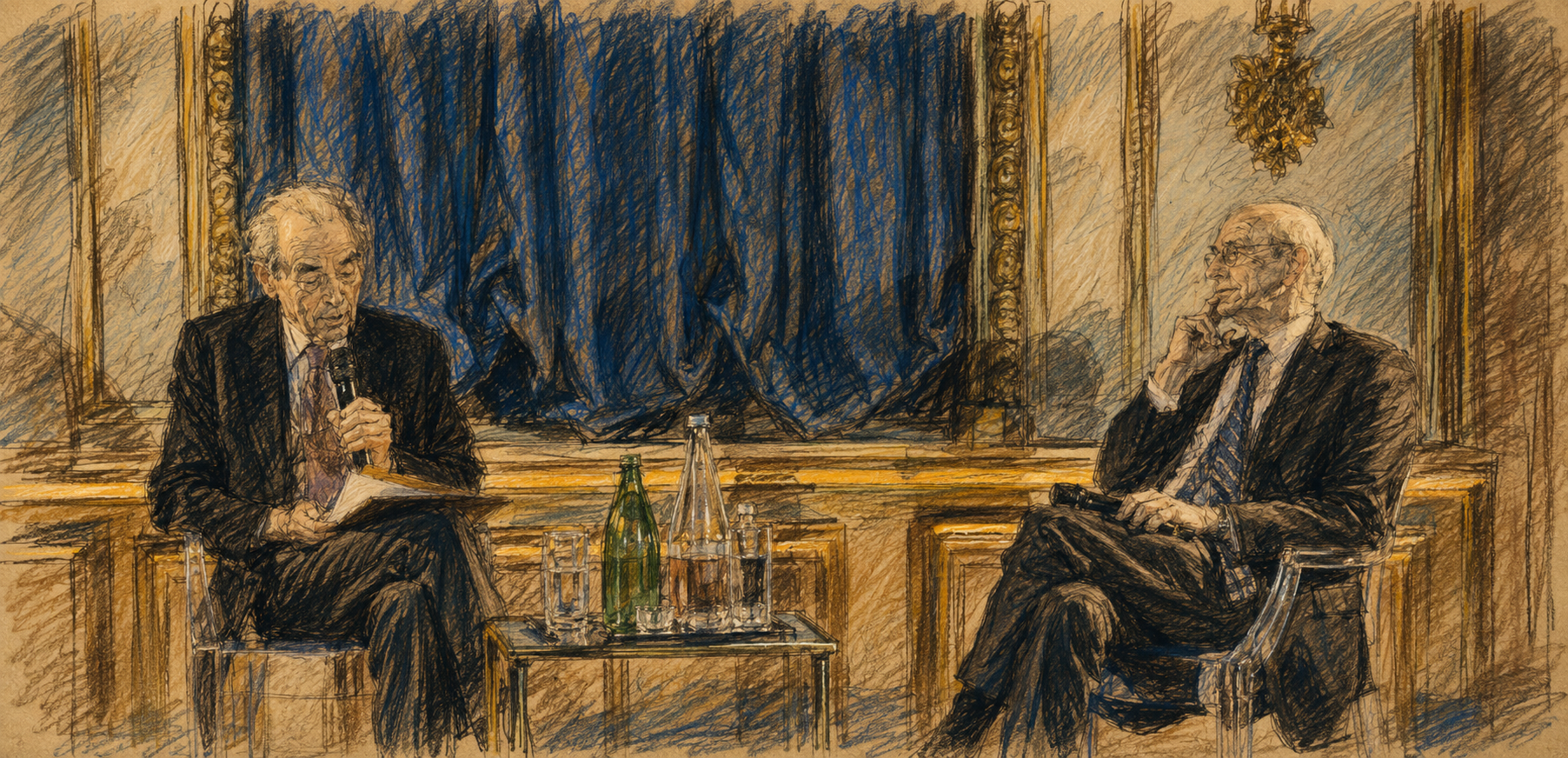
The following text is a tribute to Robert Badinter, written in French by Justice Stephen Breyer on June 13, 2024.
The first time I met Robert Badinter was in 1995, when a few members of the United States Supreme Court had gathered in Paris to discuss jurisprudential challenges with members of the French Constitutional Council. What, for example, are the advantages and disadvantages of a judicial system where judges may write dissenting opinions? The man presiding at the head of the table—the President of the Council—was clearly grave, deeply informed, and concise in his remarks (even on highly technical matters), and he seemed determined to transform an institution that had, until then, primarily concerned itself with electoral disputes into one that could advance another vital cause: fundamental human rights. This man, the President of the Council, struck us like a bolt of lightning. His name was Robert Badinter.
Later, we learned that he had been instrumental in abolishing the death penalty in France. He brought his gifts as a lawyer to bear on this cause. In cases where he defended dangerous criminals, for instance, he would say to jurors: “Whatever decision you reach in this case, a day will come when the death penalty is abolished.” And he would often add: “If you vote now to impose this sentence, what will your grandchildren think of you years from now?” As Minister of Justice, he ultimately succeeded in abolishing capital punishment. From that moment on, it could be said that “French justice is no longer a justice that kills.”
But he did far more to advance the cause of human rights. As a Senator, he championed the decriminalization of homosexuality. With his keen intellect, he helped persuade the French government to support the creation of an international tribunal to prosecute human rights violations. He proposed that France join this tribunal on a trial basis, which it did. When the trial proved successful, the country became a permanent member of the International Criminal Court. He used his eloquence to fiercely criticize any political group’s attempts to erase or minimize the horror of the Shoah.
In doing so, he underscored the fact that he was Jewish, and that he had lost his father and many close relatives in the concentration camps. He would say that in him, being French and being Jewish were inseparable. During the commemoration of the Rafle de Lyon—the roundup in which his parents were arrested by the Nazis—he expressed his horror at encountering, even today, an antisemitism that may wear new clothes but ultimately reveals the same old irrationality and hatred.
How did he advance this cause—the cause of human rights? By keeping it at the very core of his being throughout his life, as a lawyer, as a minister, as President of the Constitutional Council, as a Senator, and even afterward. By explaining it to younger generations, so that the country would never forget. By delivering clear speeches. By using his intelligence to find ways to move it forward in a manner acceptable to the greatest number.
He wrote books. One explains how Louis XVI (with the support of Enlightenment thinkers) sought to emancipate Jews in the 18th century. Another tells the story of a young Jewish lawyer who, during the war—because of the Nazis and the antisemitism of the Paris Bar—fled to the South, where he joined the Resistance. He was killed, and the author writes that he found what he was seeking: to die for France, for a certain idea of France. More recently, Robert Badinter wrote a poignant book: the story of his grandmother, Idiss, who had fled the pogroms of Russia with her family to find refuge in France.
He organized conferences, such as the one in Bonnieux two decades ago, where he invited a Supreme Court justice and French, English, German, Italian, and American philosophers to discuss judicial decisions, human rights, and international law. Later, this conference led to the publication of a book in the United States.1 There were many other conferences—in the United States, in Europe—where we had the opportunity to engage with him and others in the pursuit (one would hope) of a protective global legal order.
He loved speaking to young people about these issues; he welcomed their questions, whether friendly or hostile, because he knew that the future of human rights rested in their hands.
Through his actions, his ideas, his words, his articles, his books—through all of this, his voice (whether written or spoken) and his life became something extraordinary for France. He became the voice, and the symbol, of morality—in law and in politics.
He became the voice, and the symbol, of morality—in law and in politics.
Stephen Breyer
Come closer, Youth—youth of France, of the United States, and of the world. Behold the life of Robert Badinter. Consider how this life has become, everywhere, a symbol of law’s capacity to protect human rights and freedom. When he was young, at the end of World War II, Western Europeans and Americans embraced as fundamental principles the need to strengthen democracy, to uphold human rights, to pursue true equality, and to operate within the rule of law. For a long time, Americans and Europeans worked together to minimize conflict and achieve these goals. And now, more than ever, we must uphold these values.
Robert Badinter’s long life reminds us that, even if we inhabit different nations, today we must—more than ever—work together, as nations and as individuals, to achieve these ends.
Cicero tells us that “it is our duty to treat with honor and reverence those whose lives demonstrate activity in accord with high ethical standards, and who have rendered effective service to their country.” There, Robert, lies our duty to you.
Look upon this life—its spirit of public service, its embodiment of law at its finest—the life of Robert Badinter: advocate for the good, a consummate citizen of his country, statesman, and great citizen of the world.
1 Stephen Breyer and Robert Badinter (Ed.), Judges in Contemporary Democracy: An International Conversation, NYU Press, 2004.