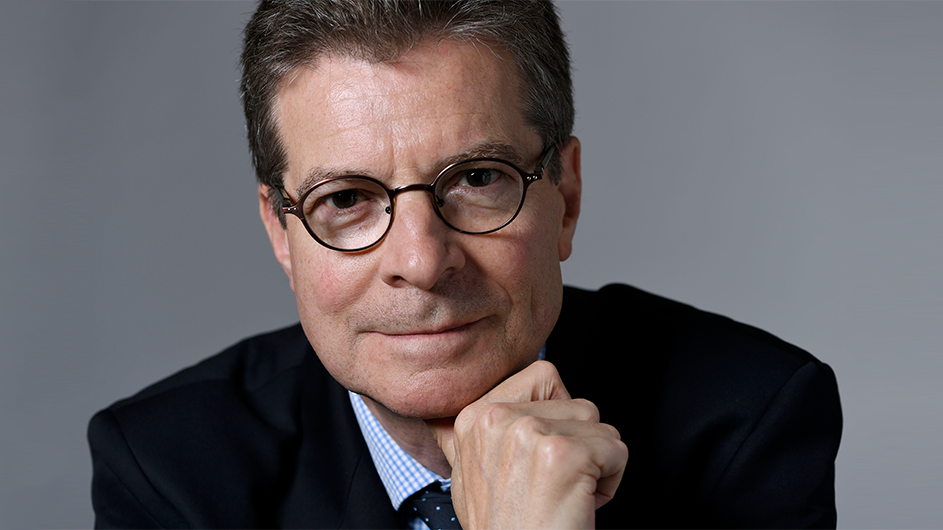
Antoine Compagnon, a professor of French and comparative literature at Columbia University, was elected to the Académie française in 2022. He is a member of the American Academy of Arts and Sciences and the Academia Europaea, and a corresponding fellow of the British Academy.
After studying at the École Polytechnique and the École des Ponts et Chaussées, you said that “building bridges wasn’t my passion.” What led you to the humanities?
I believe that, for everyone who turns to the humanities, it is reading that leads them there. It is because we read books, because we want to read more, that sooner or later, we want to write them. So, little by little, we want to be part of this world of books. And I was undoubtedly better suited to the world of books than to the world of bridges.
After turning to the humanities, was your scientific training still useful to you?
I’ve always remained very curious about science, and I’m a passionate advocate for it. I have nothing against it, and I’m glad to have benefited from it myself. I don’t deny it. Having a scientific background offers certain advantages when you turn to culture, literature, and history. I didn’t approach these disciplines with quite the same method as others, because I didn’t have quite the same initial training. So there are many reasons why I have always placed a high value on clarity of expression—something that is perhaps not always emphasized to the same degree among literary scholars or among those working in culture, ideas, and philosophy. What I certainly retained from my scientific training is a concern for always being understood, and for having students leave my classes, and readers finish my books, feeling more intelligent than when they began.
At institutions like Harvard University or Columbia University, where GenEd and the Core Curriculum shape the curriculum, do you consider a liberal arts education indispensable?
I taught for many years in the Literature Humanities program at Columbia University. When I arrived at Columbia, everyone taught that course. So I taught the “Masterpieces.” At the time, some thirty years ago, this program was exclusively Western. That, too, has evolved: it is no longer the same Core Curriculum as back then.
I can say that when you meet former Columbia students today who are in their 40s, 50s, or 60s, there is no doubt that most of them were deeply shaped by that experience. Some got nothing out of it, it must be admitted. Others were deeply bored by it. But when you talk to them, it’s striking to see to what extent certain readings have left a lasting impression.
I knew many of the older alumni; they were men, since women had not yet been admitted to Columbia College at the time. When I arrived in 1985, there were women in their first year, but no women yet in the graduating class.
All that has changed a great deal. But when you talk to them about Dante’s Inferno, there is no doubt that it left a mark on them. I am always happy to see that they have read these works. Every Columbia student has read Montaigne, and that is very good.
And, in fact, this is not the case in France, since there is rapid specialization after the baccalaureate, and the loss of that liberal arts education—both scientific and literary—that American universities allow, or even require, at the B.A. level, which is a real asset.
Could you tell us about your experience as a teacher in the United States?
You know, I’ve been teaching at Columbia University for 40 years now, so this isn’t new to me. I arrived at Columbia in 1985; last fall marked my 41st year of teaching.
Students at Columbia have changed a lot in 40 years: they’re not the same at all anymore. I’ve also taught in France for nearly 50 years, since 1975. So I know French students well. There, too, they’ve changed a lot.
Forty years ago, the difference between French and American students was much greater than it is today. There was less interaction between them, less movement. Columbia was still a university that recruited primarily from within the country.
Today, this university, just like Harvard or Yale—these major institutions—has become very global, very international. There are students coming from all over the world.
And, at the same time, students around the world are much more alike today. That wasn’t the case 40 years ago. They weren’t alike: they had very different strengths and weaknesses depending on their country.
When you go today to China, when you go to Japan, the students are similar. But that wasn’t the case at all 40 years ago, or even 30 years ago.
You’re a leading expert on Proust: what drew you to his work?
Yes, I read Marcel Proust when I was a teenager, around 17 or 18. It captivated me right away. I read the entire series of volumes right away, because it had just been published in the livre de poche (paperback), which meant it had become accessible to younger readers. There was a certain democratization of literature through the livre de poche. That was my generation, and I read it at that time.
It wasn’t until much later that I became involved in editing Proust. And it was precisely this work, for the new edition of the Bibliothèque de la Pléiade, that made me, de facto, a Proust specialist. It is editorial work that makes one a specialist.
Because, once you’ve edited a text, you know it better than anyone else. You then become the specialist. For my part, I edited Sodom and Gomorrah in the Pléiade: for a number of years, no one knew that part of Proust’s work better than I did.
Was it really having edited it and, in a way, having meditated on it at length that drew you to this work?
First and foremost, it was having read it and been captivated by it. And then, much later, having edited it and encountered every stage of its making—in the manuscripts and the drafts. There comes a point when you become familiar with this work: you feel at home in its universe, as you become familiar with its making. Yes, you feel at home in this work. I feel at home with Proust.
And speaking of publishing and manuscripts, do you think there’s a big difference between reading a printed book and reading digital content, or books on a screen?
Yes, there is a big difference. I read a lot of digital books, especially when it comes to literary prizes, because at the Académie française, there are many prizes to be awarded. Since it’s very cumbersome to travel with a lot of paper books, I ask to receive them in digital form so I can read and evaluate them.
But I’m well aware that I don’t read the same way on a screen as I do in a printed book.
Reading a book on paper is very spatial: memory doesn’t work the same way when we read on a screen. In a printed book, you remember a passage located in a specific place, on a specific page, in a specific part of the volume. From this perspective, the book is almost a perfect object: it’s a kind of box in which you can pinpoint passages.
The digital book, on the other hand, is more like a ribbon that unrolls. And I think we forget more of what we read in digital form. Also, I sometimes don’t finish certain digital books, whereas I would likely continue reading them if they were in print.
But what is my opinion worth? I was raised on paper books before switching to digital. My brain, my habits—all of that is shaped by the printed book. Younger generations, like yours, who are “digital natives,” likely have a different relationship with it: perhaps their memory is more in tune with the digital medium.
I’m somewhat skeptical, however, because there are now many neuroscience studies comparing digital reading with reading on paper. And this research tends to show that reading printed books is more beneficial for cognitive development than e-reading.
Do you also read foreign literature? And, among these works, what do you generally enjoy?
I do read foreign literature from time to time. I read American literature in particular. This ranges from more classical literature, such as Henry James, which I enjoy reading, to more contemporary authors like Philip Roth, whom I also read with pleasure. Recently, I’ve also reread Joseph Conrad, for example.
Between 1996 and 2011, you served on the jury for the French-American Translation Prize awarded by the French-American Foundation in New York. Do you think artificial intelligence could replace the work of a translator, or does translation remain, above all, a literary act?
I think artificial intelligence will largely replace a large share of translation work. It’s already doing so. Today, in many cases, publishers produce an initial translation using artificial intelligence before submitting the resulting text to professional translators for review.
To be honest, this actually gives them even more work, since they have to check and proofread everything. So it’s not certain that this actually saves them any time.
But I must admit that my experience with AI translation has shown me that it is now of remarkable quality. Obviously, certain highly literary texts remain, for the time being, beyond the reach of machine translation. But the level achieved is already quite extraordinary.
We don’t yet know exactly what will become of translation, whether it’s novels or poetry. There are clearly limits. Artificial intelligence cannot translate everything with the desired quality, but it is already capable of doing a great deal.
Our interview will appear in the “Invitation to Travel” section. Since summer is the season for travel and daydreaming, you’ve published the series A Summer with…, of which A Summer with Pascal has been translated into English and published by Harvard University Press. Why Michel de Montaigne, Charles Baudelaire, Blaise Pascal, and Colette? Is there a common thread among these authors?
There is one main thread: these are authors I love. Also, a new one has just been published, devoted to painting, titled Un hiver avec Henri Matisse. So we’re moving on to winter, and to a painter.
The principle remains the same: these are writers and artists I love. We started with Montaigne, who was the first in the series, because he’s an author everyone appreciates, a writer of almost universal appeal.
Next, Baudelaire: I’ve done a lot of work on him and so he’s an author I feel especially close to. Pascal, of course, because he is, in a sense, Montaigne’s equal or counterpart.
As for Colette, it was pointed out to me that I’d already covered enough men, and that it was time to include a woman in the series. And Colette is a writer I’ve always loved very much.
And then, now, Matisse: we wanted to launch a series dedicated to painters, and I thought that Matisse was, once again, an artist that everyone loves. So it was good to start with him.
Can the classics be “vacation” reading? For this summer, which volume from the A Summer with… series would you recommend we start with?
Well, I believe that in English, A Summer with Michel de Montaigne and A Summer with Blaise Pascal have been translated. I’m not sure if the other two, …Charles Baudelaire and …Colette, have been.
Montaigne and Pascal form a sort of pair, as I mentioned earlier. Almost all of Pascal’s work stems from reading Montaigne: the Pensées are, in a way, a reaction to the Essays. They wouldn’t exist without Montaigne’s work.
I would therefore recommend reading this pair, especially since they are available in English.
Which author would you like to feature in a future “A Summer with…”? Do you have other authors in mind, or would you now like to focus more on artists, particularly painters?
Look, no, I don’t have any specific plans, because there have already been a dozen “summers” since Montaigne. I’ve written four myself, and that’s enough.
There are, of course, one or two authors I would be happy to write about, but there is no particular urgency. More than anything, there should be more women—both among the authors of these books and among the figures they choose as their subjects.
And speaking of which, which authors do you have in mind?
If I had to choose one, I’d suggest Stendhal, because he’s another author I really like, whom I haven’t worked on extensively, and who seems especially rich.
For this to work, you need authors whose work and lives offer a certain variety. Colette, for example, was very easy to cover, because she lived a long life and engaged in a wide range of activities: she was a novelist, but also a dancer, a journalist, and active in the theater. She is an extraordinary figure, with an extraordinary life.
So you need authors who are broad in scope and multifaceted. I think Stendhal would have been a very good fit. There are also authors like Denis Diderot whom I would have gladly chosen. And I had also suggested Marguerite Duras as another female figure.
The interview was conducted on March 3rd, 2026, by Cécile Chen (Harvard College ’29), with support from Christian Bateman (Columbia College ’27).