
Anna Bartoux — Master in Public Policy, Harvard Kennedy School, Class of 2027.
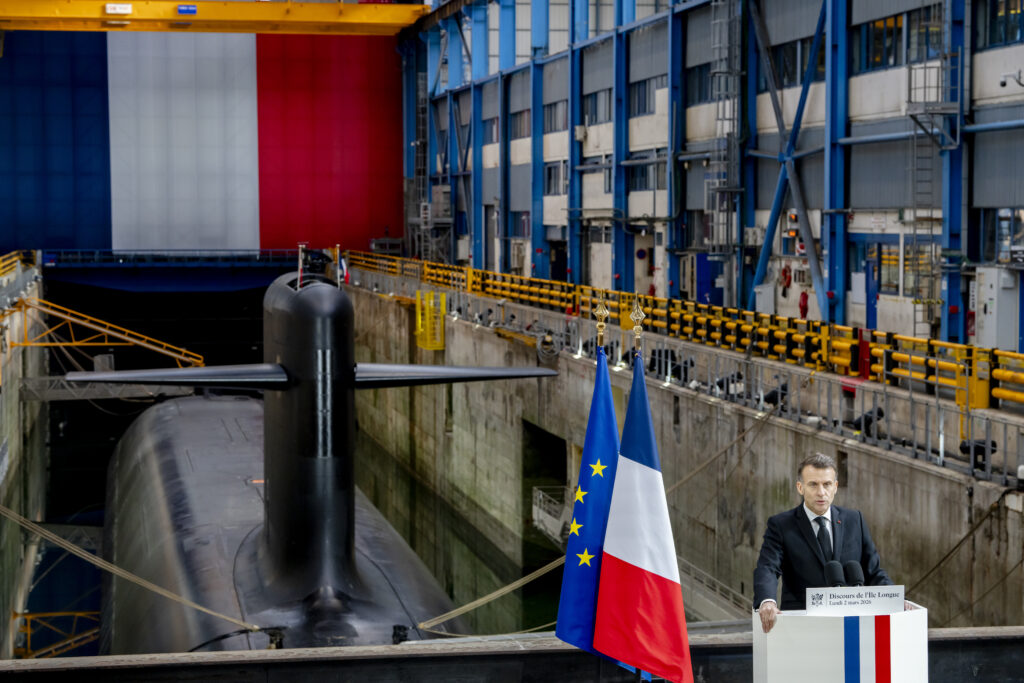
In 1960, France tested its first nuclear weapon, nicknamed Gerboise Bleue. Charles de Gaulle broke with other European leaders in insisting that France could not rely on America’s nuclear umbrella: a few years after Gerboise Bleue, he withdrew from NATO’s integrated military command structure and expelled its headquarters from Paris.1 This op-ed tells the story of how a doctrine largely born from the mistrust of U.S. power has evolved to become a fulcrum for European strategic autonomy today.
In March 2026, French President Emmanuel Macron stood before the French Navy to deliver a much-awaited address on the future of France’s nuclear policy. He announced some consequential changes—including the first increase in France’s nuclear warhead stockpile since 1992—and introduced a new concept of “forward deterrence,” which builds on what he had previously called the “European dimension” of France’s vital interests.2 This will include a framework for more frequent consultations with European partners, expanded allied participation in French nuclear exercises, and new institutional mechanisms to coordinate threat assessments and responses.
This may seem like a move toward U.S.-style extended deterrence, and although there are similarities, it bears highlighting some fundamental differences.
First, despite the nuclear warhead increase, France will not seek parity with Russia.3 Paris lacks both the industrial capacity and strategic rationale to do so. The doctrine will continue to rely on “strict sufficiency,” which, despite the wording, is more akin to a benchmark for the ability to inflict unacceptable damage without drifting toward a logic of limited nuclear war than a clear limit on the number of warheads France can develop. As the president made clear in his speech, he has no interest in lowering the threshold for nuclear use by developing more “flexible” nuclear options or engaging in an arms race with Russia. Instead, Macron is likely hinting at a modest increase in forces—any more significant buildup would likely require building new fissile material production facilities, as France decommissioned its existing ones in the late 1990s.4 This move may not be all that militarily significant, but it is clear that France is making greater commitments to European security—a signal that is likely intended to reassure its allies.
Second, there will be no “sharing” of French nuclear weapons as the U.S. has done through NATO. Macron and other French senior officials have repeatedly emphasized that they have no intention of basing nuclear weapons outside of French territory, and this speech is no exception.5 Given domestic opposition to any “dilution” of the French deterrent—and to steps that would make it seem less independent—any such move would be political suicide for the President.6 Still, France has, in the past, organized dispersal activities of nuclear-capable Rafale fighters in an exercise over Sweden, describing it as a strategic exercise designed “to assert our presence, strengthen our partnerships, and demonstrate our commitment to European security, alongside our allies.”7 More exercises like this are likely to happen in the future, which signals greater commitment to Europe, and with it, a willingness to develop an alliance-wide outlook.
Last but not least, Paris will not seek direct financial support from allies for its nuclear force modernization, as this too would undermine the independence and sovereign control which sit at the core of France’s understanding of credible nuclear deterrence.8 However, indirect allied support could, over time, cement the credibility of defending shared interests. Macron said as much in his speech, where he described the contributions needed from allies in three domains where Europeans lack independence from Washington: Early warning systems, air defense (including anti-missile and anti-drone capabilities), and long-range conventional strikes.9
However, Macron’s recent speech did make some substantial changes to France’s approach to nuclear policy, and it is worth diving into what this new “forward” deterrence approach entails.
Although different in name, in substance, this is as close to an official extension of French nuclear deterrence allies will likely get. U.S. management of its alliances during the Cold War showed that extended deterrence requires more than just warheads—over time, Washington and its allies developed a dedicated infrastructure of joint exercises, consultations, shared planning, and other institutional rituals around this commitment. Macron’s new concept takes these principles to heart, and it highlights Paris’ willingness to concretize what was until then a largely rhetorical expression of the European dimension of French vital interests.
Over the next couple of years, the main challenge will be to convince Northern and Eastern allies—particularly states that border Russia—that this commitment is credible.
These states operate from radically different historical experiences, and their collective memories bear the scars of Russian occupation. For them, Moscow poses an existential risk, and they are willing to accept greater costs in confronting its aggression. This disparity in threat assessment will likely create tensions within any future defense arrangement, but for now, it seems allies including Poland are responding favorably to France’s overtures for strategic dialogue, a sign they are taking it more seriously.
Still, important questions remain, including with respect to the fate of American extended deterrence. Can Europe seriously engage in France’s “forward” deterrence approach without weakening the credibility of NATO’s own extended deterrence? And more generally, can France assume greater responsibility without incentivizing American disengagement?
Macron’s strategy attempts to prepare for a world of diminished American guarantees without accelerating that outcome. Will this suffice? Credibility in deterrence, especially when it encompasses allies, is always contested. European leaders will likely continue to question Paris’ commitments, and domestic political constraints may limit the long-term reach of Macron’s new concept.
But one thing is clear: Paris is no longer content to let its nuclear arsenal speak only through silence, and Macron’s speech has opened a new chapter in French nuclear history.
1. NATO, “1967: De Gaulle Pulls France Out of NATO’s Integrated Military Structure,” NATO News and Events, March 3, 2009.
2. Présidence de la République française, “Discours d’Emmanuel Macron lors de son déplacement sur la base opérationnelle de l’Île Longue,” video, March 2, 2026, from Élysée.fr; Emmanuel Macron, “Discours du Président Emmanuel Macron sur la stratégie de défense et de dissuasion devant les stagiaires de la 27e promotion de l’École de guerre,” Élysée, February 7, 2020.
3. In other words, Paris will not seek to develop nuclear weapon capabilities on par with those of Russia (or other adversaries), whether in warhead count or system types.
4. Nuclear Threat Initiative, Nuclear Disarmament: France’s Concrete Commitment — Dismantling the Fissile Material Production Facilities for Nuclear Weapons, working paper (Washington, DC: Nuclear Threat Initiative, March 15, 2009).
5. “Les défis de la France : Interview du Président Emmanuel Macron sur TF1,” Élysée, May 13, 2025; Rudy Ruitenberg, “France shares intel with Ukraine as Macron floats nuclear umbrella,” Defense News, March 6, 2025.
6. In 2023, the Rassemblement National attempted to amend the constitution to state that the French President is responsible for nuclear deterrence, and that this is a purely national undertaking that cannot be shared; “Rapport d’information N°1112,” 16e législature – Assemblée nationale, April 24, 2023; In 2024, La France Insoumise took a similar stance; Lachaud, Bastien, and Aurélien Saintoul, “Emmanuel Macron a Tort. La Dissuasion Nucléaire Ne Se Partage Pas,” La France Insoumise, February 3, 2024.
7. Thomas Newdick, “French Rafale Fighters Project Power Forward To Sweden,” The War Zone, April 23, 2025.
8. Assemblée Nationale, “Compte Rendu: Commission de La Défense Nationale et Des Forces Armées,” January 2023.
9. Présidence de la République française, “Discours d’Emmanuel Macron lors de son déplacement sur la base opérationnelle de l’Île Longue.”