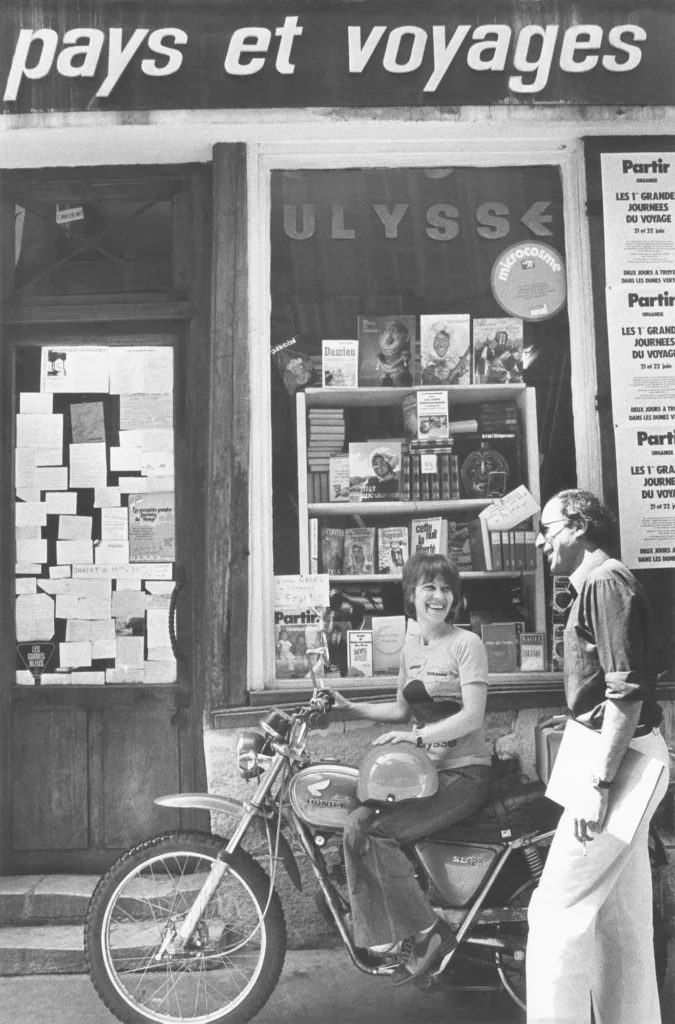
Catherine Domain, born in 1941, is the much-loved and respected owner of Ulysse, Paris’s first bookstore specializing in travel literature. She often recounts that in her youth, her father gifted her the equivalent of a year’s tuition at Harvard today, which enabled her to travel across continents on a modest budget of “a dollar a day, sometimes two,” for nearly a decade. The origin of this sum was remarkable in itself, as it came from the trade of a magnificent house that her grandfather had won at the casino in Hendaye. It subsequently set Catherine on a path of lifelong travel, marked by long journeys such as a trip from Geneva to Kathmandu in an old Volkswagen and journeys to the Cape Verde islands or the Seychelles archipelagos.
At a certain point between Colombo and Surabaya, Catherine decided to return home and founded Ulysse. She opened it in 1971 on the picturesque Île-Saint-Louis, in a space whose owners, busy playing poker near the entrance, quite naturally ceded the premises to her. Since then, the bookstore has become an institution for local residents and seasoned travelers, as well as the meeting place for her Cargo Club, dedicated to sharing knowledge and stories about cargo travel. Catherine also established the Pierre Loti Literary Prize and the Ulysse Club of the World’s Small Islands. For all these reasons, she was awarded the National Order of Merit in 2012.
During our interview and her latest session of the Cargo Club, I was moved by Catherine’s joy, the simplicity of her surroundings, and her talent for exposing habits and conventions. More than that, she conveyed a sense of profound freedom and, perhaps for this reason, reminded me of Simone de Beauvoir, who, in the words of her student Jeanson, “never gave up on living the absolute—not, no doubt, by claiming to attain it in this world of the relative, but by persisting, against all odds, in making it a law for oneself.”
You once said that literature gives us a kick in the ass. Do you still feel that way?
Oh yes, absolutely, because literature enables us to open the right doors. And travel can be part of that. As Ella Maillart [the legendary adventurer, born in 1903] said: “You have to go and see for yourself.”1
My passion for reading was always insatiable, and, like my grandfather, a navigator, I was curious about what lay beyond the mountains. So I was very fortunate that my parents were not “obligeurs” (that is, excessively demanding or strict). My upbringing did not impose limitations upon me, and I was able to make my own choices.
What were those choices like for you?
It frequently came down to saying no. From the age of seven, I would refuse things I did not want.
I once traveled with my boyfriend to his cabin in Verbier. The moment we arrived, he sat himself at the table, and I noticed a subtle tapping of his fingers. As if to say, “What’s for lunch?” That day, I knew I would never get married! I told him that whoever was hungriest would make something “à bouffer” (to eat; to pig out or stuff oneself with).
I am struck by your use of the crude verb “bouffer.” It evokes Annie Ernaux’s usage in her 1981 novel, La Femme Gelée. The work, described by Le Nouvel Obs as a mirror for “the insidious erosion of ideals of [gender] equality,” delivers a sharp critique of domestic life.2 Has your adventurous spirit led you to a different conception of love?
Yes, I haven’t renounced love! No one should have to do that.
My advice is simply to not let time slip away while waiting for the other person to return. In short, “ne surtout pas s’attendre” (absolutely not waiting for each other); there must be reciprocity, a mutual agreement to grant the other person the freedom to go wherever and whenever they wish.
A great love will accept your desire to live to the fullest. When I opened Ulysse, in 1971, my partner ran the shop in my place for a month every year so that I could travel! This requires a lot of talking and explaining yourself to make sure you are understood. For you are right, as Alexandra David-Neel wrote to her husband, “What world would we be in if none had followed their chimera?”
Friendship also sustains your life, as I noticed and found so uplifting at your Cargo Club. I know you maintained a close relationship with Nicolas Bouvier, whose books are lying on your table. How did you recognize that L’Usage du Monde was a masterpiece in the 1960s and 1970s, when it was still largely unknown and self-published? 3
Because it was exactly like my own travels! He had understood everything and put it down on paper magnificently. People did not get it because they were not traveling.
{ Bouvier’s finest sentence is in this book: […] “Traveling outgrows its motives. It soon proves sufficient in itself. You think you are making a trip, but soon it is making you—or unmaking you.”
Bouvier further reflected upon his formal education as “potted culture” and “intellectual gardening.” Do you also regard travel as having been your schooling?
Yes, because traveling is governed by natural curiosity. It has taught me tolerance, admiration, and humility. You really have to go and see for yourself!
Can you tell us about your long-standing friendship with Ella Maillart, who passed on that saying to you?
Ella’s book, Oasis Interdite, [which recounts an eight-month crossing of China from east to west through forbidden regions in 1935] captivated me so much that I read it in a single afternoon.4 I then lamented to my friend Roland, “What a shame she’s dead!”—to which he replied that she was very much alive and that we should go meet her for lunch. She made us “un doubitchou dégueulasse” (a Swiss term for an unappetizing meal or dessert) and we followed her for a walk. We could not keep pace with her!
Meeting Ella left a deep impression on me. I found myself speechless, unable to say a word, and could only watch her and listen intently to her words. So during my subsequent travels in Asia, I sent her postcards along the way.
That was the beginning of a sincere and disinterested friendship that lasted twenty years. Afterwards, I dedicated myself to getting her works republished.
Let’s talk about literary friendships. It seems to me that Henrietta Stackpole, journalist and woman of letters in Henry James’s Portrait of a Lady, bears a strong resemblance to Ella. As Henrietta traverses England and Continental Europe, she perceives the world as a tapestry whose reverse alternates between inner and outer life. Her lived experience changes depending on which aspect is presently manifest or obscured. Does this metaphor resonate with you?
(Pause) To me the word “tapestry” implies a fixed object, something that can be detached and put away. But I find the “outer life” most striking in the morning, when I traverse the Rue Saint-Louis en l’Île at 6 am and hear people snoring. This experience is always enchanting, because it is real life.
The Île Saint-Louis is definitely a magical place. Over the years, I have met an amiable cheesemonger, whose twin brother also owns a fromagerie on the Left Bank, a former member of the Italian Red Brigades who became a predatory landlord, and the heir to a Turkish sugar dynasty…. What kinds of encounters do you have there beyond the facades of the buildings?
So what was in the Italian landlord’s secret apartment hatch? (Smile). I have been extremely fortunate with my bookstore, Ulysse. Such a diverse clientele has crossed the threshold over the past fifty-five years, and people invariably present themselves “dans un état d’esprit formidable” (in high spirits) since they are about to embark on a trip!
Something I said elsewhere is that our visitors come from all walks of life: from the solitary travelers to the grandmothers taking their grandchildren on an outing; from the depressed guy seeking respite to the idealist embarking on humanitarian work…5 You will find people from all ages, all professions, taking all means of transportation. Every person who enters represents a possibility for a new friendship.
You could not write your dissertation in the bookstore, but it is certainly a good place to spend a pleasant afternoon.
In interviews, you are often asked what prompted you to open Ulysse, first in Paris, then in Hendaye, by the sea.6 You often say that when you returned home after a decade of traveling, you were thirty years old and determined not to have a boss or any employees…
…. And in the past, I was forced to visit many different bookstores to plan a single trip – none of them offered everything you needed in one place! I also was inspired by my maternal grandfather, who ran a bookstore in Bergerac! As a child, it impressed me that his sales assistant was the sister of Garnier, the architect of the Paris Opera House.
The only downside was the financial aspect. One day, while my grandfather was in a coma, he started making counting gestures with his hand, as if he were tallying money from the cash register. I swore to myself, then, that I would only check the accounts at the end of the month.
Long before this, in 1959, you were awarded a scholarship that enabled you to complete your final year of high school in California. How do you look back on that experience now?
I wholeheartedly subscribed to the culture, “à fond la caisse”! I was seventeen then and lived in Menlo Park, near Stanford, for a year. It was tremendous because I had my own car. I also crossed the United States by bus. That being said, I gradually began to realize the tense nature of relationships between young men and women.
Unlike the vibrant community in Paris, American youth had divided themselves into two distinct groups that struggled to communicate with one another. The sole way to meet was the “date,” which served as a prelude to sexual intimacy.
Personally, I did not really have any reason to complain, since I was often asked out. But I observed that other young women were being excluded, which held them back. You are right that it all sounds like Simone de Beauvoir during her first trip to the East Coast, as true communication is a freedom that presupposes the existence of other freedoms.7 I could clearly sense the societal pressure was pushing girls to conform to certain behaviors. When I was invited to give a talk to an audience of several hundred students, that was the topic I chose to address.
But I have always given the American people the benefit of the doubt.
When you tell me about your travels, I notice that you never really mention places, itineraries, or the dates, even though you have explored France, Greenland, Tibet, Indonesia, you speak fluent Spanish… Is that because such lists do not really matter to you?
Yes, for what I truly loved in my travels was not the itinerary, the specific route, but the state of being “en voyage,” the freedom to alter my plans at any moment. I traveled in France enormously, throughout its various regions, and no destination stands out as more memorable than the rest.
Affording a meal and accommodation on one, or at most two, dollars a day felt like a luxury in my youth. I even recall a priest in New Guinea offering me a table to sleep on.
It also mattered a lot to me to prepare my travels by reading about the region and studying maps.
In contrast, Sylvain Tesson, arguably the most renowned travel writer in France, chose to embrace a sedentary existence and to only read Jünger, Chateaubriand or Karen Blixen during his stay in a cabin near Lake Baikal, in 2010.8 What was your reaction to that?
What he did was not a voyage; it was rather a hermitage! None of what he read had anything to do with the region, and he did not venture out of his cabin to explore the forest.
You can certainly read unrelated poetry or novels while traveling, and I love the anecdote that you mentioned about taking Liane de Pougy’s memoirs on a Soviet train, but this should serve only as an intermission, an interlude.
I wonder what your thoughts are on the travel vlog format, which became mainstream during the same 2010s?
I think traveling, much like plunging into literature, is a solitary pursuit best experienced without an audience. It is only in hindsight, when the time is right, that you can share what you deem worthy of sharing: what brings comfort to others, what shows that there are elements in the world that we can absorb and pass on.
Furthermore, vlogging is, by its very nature, a form of commercial promotion, which goes against the spirit of travel.
My final question: I was impressed by a piece in Condé Nast Traveler, which featured you at various sites, including a temple in Seoul, Borobudur in Indonesia, and with the holy stupas of Tibet.9 Has your experience of travel given you a greater sensitivity to the sacred?
It made me appreciate the vastness even more. That feeling was particularly strong on a plateau in Myanmar (formerly Burma). I even considered staying, but, ultimately, I left anyway.
LOCATION: 26 Rue Saint-Louis en l’Île, 75004 Paris
HOURS: By telephone, call 01 43 25 17 35
THE CARGO CLUB: Every first Wednesday of the month for the apéritif
Interview conducted on March 3, 2026, by Marie Suzanne Fleur Prunières, PhD Candidate in Romance Languages and Literatures, Harvard University.
1. Ella Maillart, official website, https://www.ellamaillart.ch/.
2. “You’ve Never Read Annie Ernaux? Here’s Where to Start,” Le Nouvel Obs, October 6, 2022, https://www.nouvelobs.com/bibliobs/20221006.OBS64212/vous-n-avez-jamais-lu-annie-ernaux-voici-par-ou-commencer.html.
3. Nicolas Bouvier, L’Usage du Monde, Éditions La Découverte, https://www.editionsladecouverte.fr/l_usage_du_monde-9782707179012.
4. Ella Maillart, Oasis Interdite, https://www.bibliothequesonore.ch/livre/15431.
5. Catherine Domain, video interview, YouTube, https://www.youtube.com/watch?v=gRb4td0niXg.
6. Librairie Ulysse in Hendaye, video, YouTube, https://www.youtube.com/watch?v=RACOT4ocWks.
7. Simone de Beauvoir, “Simone de Beauvoir Visits New York,” The New Yorker, February 22, 1947, https://www.newyorker.com/magazine/1947/02/22/simone-de-beauvoir-visits-new-york.
8. Sylvain Tesson, Dans les forêts de Sibérie, Gallimard, 2011, https://www.gallimard.fr/catalogue/dans-les-forets-de-siberie/9782070129256.
9. “Primera librería de viajes: Ulysse, París,” Condé Nast Traveler, https://www.traveler.es/viajeros/articulos/primera-libreria-de-viajes-ulysse-paris-catherine-domain-entrevista/14711.