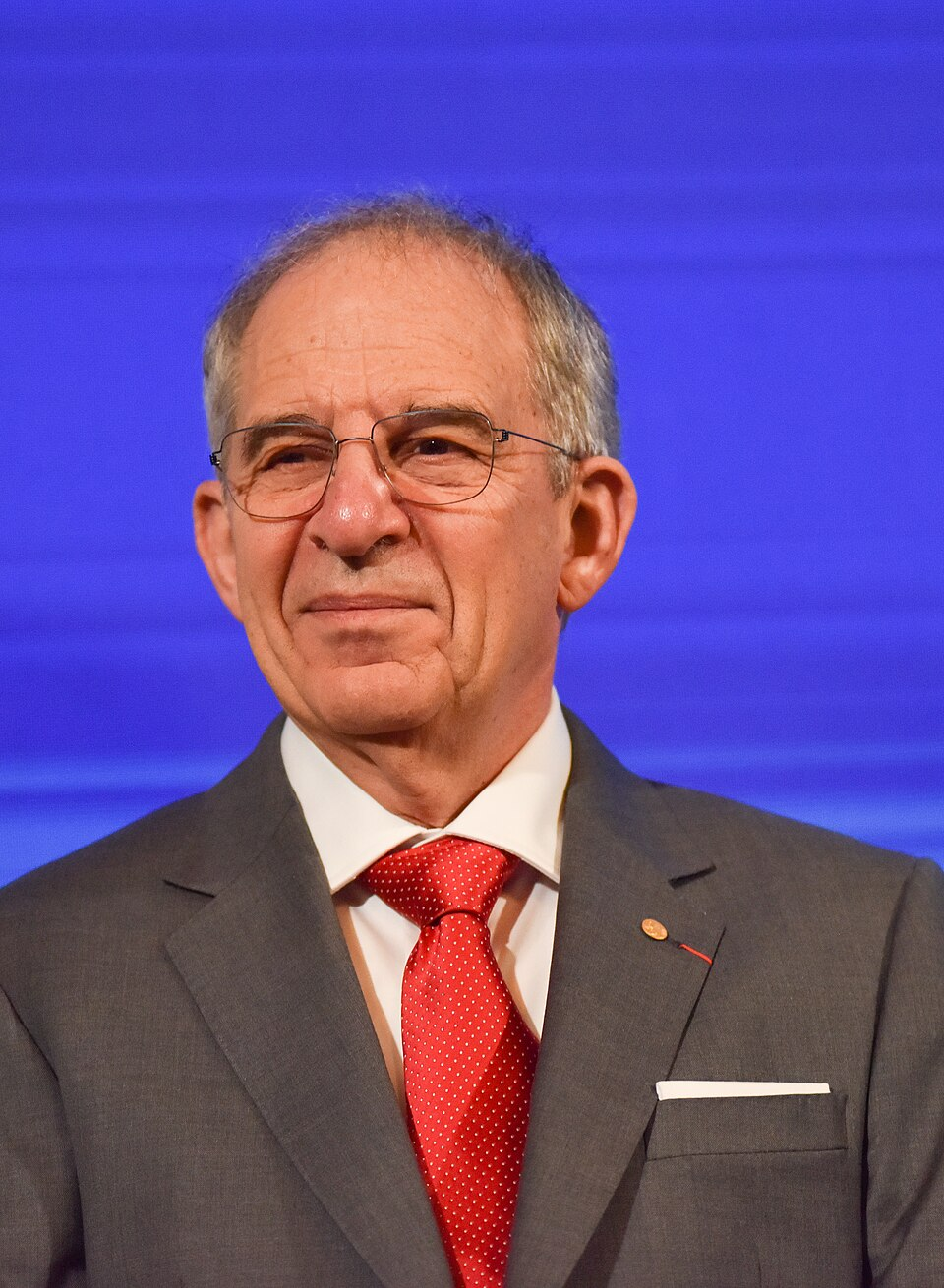
Michel Devoret is a French physicist specializing in quantum information, a Professor at Yale University, and recipient of the 2025 Nobel Prize in Physics.
Could you outline the key milestones of your career and explain what motivated your decision to pursue a scientific path between France and the United States?
I should clarify that I spent twenty-five years in France, at the University of Orsay and the CEA Paris-Saclay research center, followed by twenty-five years in the United States—first at Yale and then at the University of California, Santa Barbara, where I co-direct Google’s Quantum AI Lab. I also taught at the Collège de France from 2007 to 2012, though this only took two months each year. I moved to the United States out of a sense of adventure, not because I faced serious difficulties in France. At CEA Paris-Saclay, I led a team of remarkable individuals who were also my friends. The two research systems are complementary, each with its own strengths and weaknesses. I consider myself very fortunate to have experienced this diversity of scientific approaches firsthand.
How do you view the evolution of fundamental physics research in both countries, and what do you see as the main advantages and challenges of the Franco-American research system?
Unfortunately, fundamental research is not faring as well as one might hope in either country at the moment. Broadly speaking, French research tends to be deeper but less exploratory than its American counterpart.
How has your multicultural experience influenced your approach to research and innovation?
For me, scientific research is deeply intertwined with culture. Changing cultures means changing one’s scientific approach. Before arriving in the United States in 1982 as a postdoctoral researcher, I considered myself an experimentalist. There, I discovered I was actually a theorist! The United States allowed me to become a true experimentalist, which is more difficult in France—a country where science is highly mathematized.
For me, scientific research is deeply intertwined with culture. Changing cultures means changing one’s scientific approach.
What advice would you give to the new generation of researchers dreaming of an international career?
Completing a PhD or postdoc abroad seems essential to me. In fact, it is now very difficult to secure a position or funding without this international experience.
In your view, what role does France continue to play in advancing global science, particularly in your field?
France remains very strong in physics, likely thanks to the quality of our classes préparatoires and our magistères programs.
Could you share a memorable anecdote about how Franco-American dialogue has enriched your work or career?
When I first arrived in the United States and was setting up my lab, I had to purchase most of my equipment from Europe. For small items, I could pay suppliers directly with a credit card—something unthinkable in France unless you set up an association loi de 1901!1
What, in your opinion, are the keys to strengthening academic and scientific exchanges between France and the United States today?
Without hesitation, exchange grants and teaching buyouts, which are far too few in number these days.
How do you approach the question of scientists’ societal engagement in the 21st century? How does this responsibility differ between the two countries?
I believe scientists must help combat misinformation about climate change, vaccines, and so on. This is particularly challenging in the United States as an immigrant. In France, it is probably also difficult, but my situation there is different from the one I face in the United States.
After winning the Nobel Prize, how do you perceive your role in science communication and in promoting science to the general public?
I hope to leverage my new status as a public figure to contribute to the popularization and promotion of science through comics, podcasts, videos, and other media.
What projects or themes would you like to explore in the future, within the framework of transatlantic cooperation or with young researchers?
Transatlantic cooperation could begin with the translation of works for young audiences. Jean-Pierre Petit’s wonderful book Si on volait ? has been adapted into British English, but not yet into American English…
The interview was conducted on November 10, 2025 by Abdallah Lamane, PhD candidate in the Harvard-MIT Health Sciences and Technology program.
1. 1901 French law governing nonprofit organizations.