Brune Poirson is a former French Secretary of State to the Minister for the Ecological and Solidarity Transition, now active in the private sector, and an alumna of the Harvard Kennedy School.
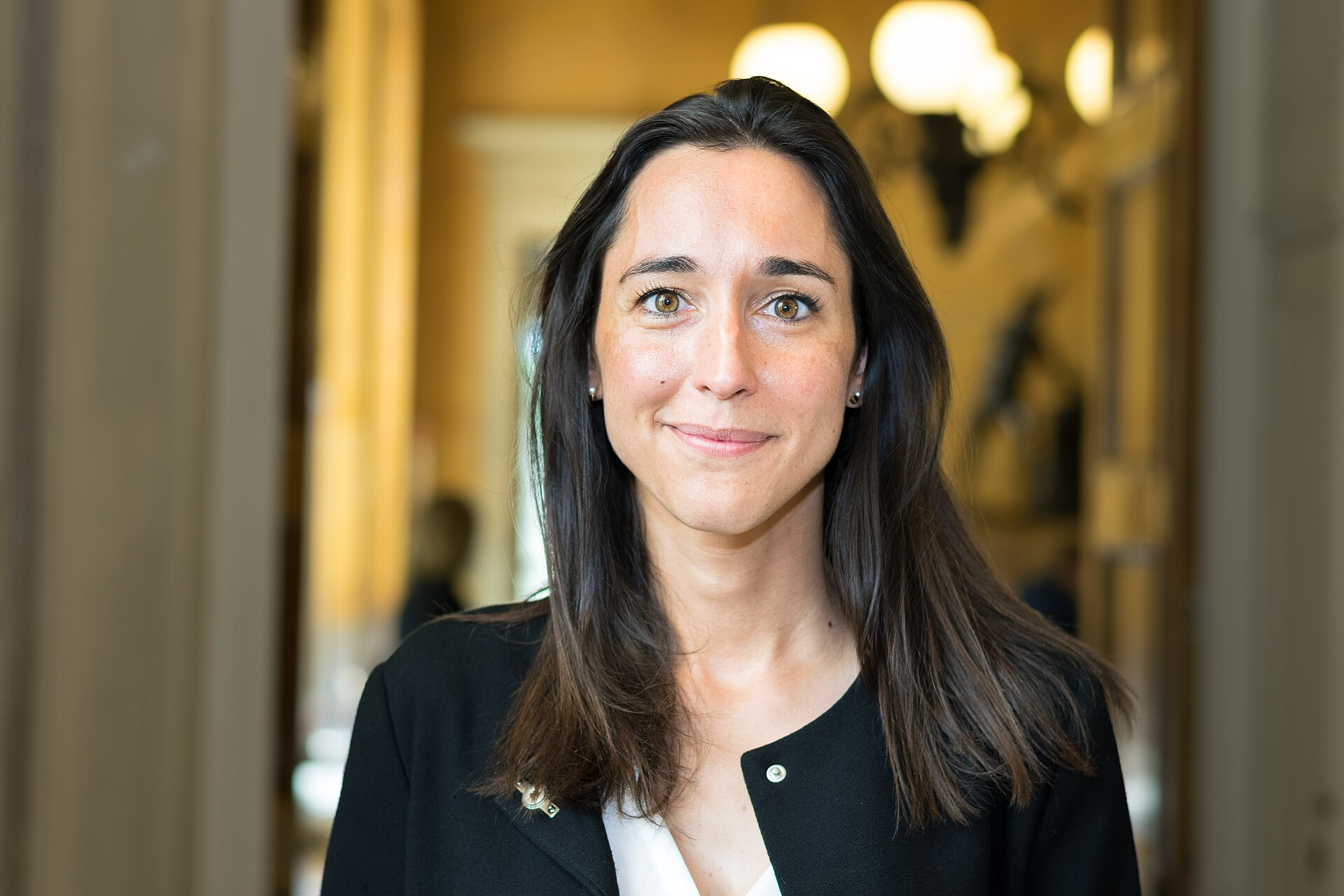
You joined Harvard after several professional experiences, notably in Laos, the United Kingdom, and India. How did these experiences contribute to your commitment to environmental causes, and why did you decide to pursue an MC/MPA1 at the Harvard Kennedy School [HKS]?
My relationship with ecology is first and foremost personal. I grew up in the countryside, and when you grow up in these areas, you quickly realize how directly our lives depend on the weather—and thus on the climate. I already observed increasingly frequent droughts in my childhood, with their very concrete social consequences. I deeply believe that to commit to a cause, you must have felt its impact in your bones. In Laos, where I worked in the far north of the country with around forty ethnic minorities, I once witnessed Chinese machinery beginning a massive incursion into a previously untouched forest. It was a defining shock. Later, in India, I worked in slums on waste management and saw an accelerated version of the consequences of climate change: what we observe in these regions today foreshadows what could happen in Europe if we fail to act. The Kennedy School represented an opportunity to consolidate all these experiences. In my view, the strength of studying in the United States lies in its ability to allow for reflection and to value professional experience, perhaps more so than in France. This time at Harvard enabled me to step back, reflect, and solidify these experiences.
Did your experience at HKS play a role in your political engagement and influence your approach to public action? What do you take away more broadly from your time at HKS?
There are pivotal years in one’s life, and my year at the Kennedy School was one of them—both positively and negatively. Above all, I learned how much we live in a world where elites are often self-centered. A memory always comes back to me: on the night of the 2016 U.S. presidential election, the hall of the Kennedy School was filled with hundreds of balloons ready to celebrate Hillary Clinton’s victory. Donald Trump’s win was unthinkable. This blindness left me deeply unsettled—and later proved very useful, particularly during the Yellow Vests crisis, in understanding the importance of staying connected to the “real France.” I also learned very concrete things: how to win an election, or how a woman can legitimately nurture great ambitions and receive the tools to achieve them, notably through the program From Harvard Square to the Oval Office.2 Intellectually, not a single course failed to be useful in my career. As for my political engagement, it already existed, both in the United States and in France. I ultimately decided to join the movement launched by Emmanuel Macron, not as an advisor or note-writer, but as a grassroots actor.
When you were Secretary of State to the Minister for the Ecological and Solidarity Transition, France positioned itself as a leader in climate action, particularly in the wake of the Paris Agreement. With several years of hindsight, what role did France play internationally in environmental matters, and what limitations did you identify while in government?
France—and the President of the Republic—did indeed assume a leading role at a time when the United States was leaving a void after withdrawing from the Paris Agreement. It is precisely in these moments of uncertainty that we risk losing hard-won progress. France’s voice helped maintain essential international momentum around the agreement. France also innovated in its methods, notably by mobilizing non-state actors—businesses, local authorities, investors—through initiatives like the One Planet Summit. This was fundamental, as states can withdraw from their commitments, whereas economic and societal dynamics must endure. However, the limitations were real. The first was a lack of coherence between international ambition and national implementation. Building international coalitions is essential, but we must also deliver at home. The second concerned our relationship with countries in the Global South. Our approach was sometimes too “preachy”: we demanded compliance with climate trajectories without providing sufficient technology transfers or concrete resources. This asymmetry certainly fueled distrust.
In his speech at Belém during COP30, UN Secretary-General António Guterres described the decade following the Paris Agreement as a failure. What, in your view, are the causes of this failure, and how do you assess the COP model?
The Secretary-General is right. The gap between stated objectives and actual trajectories is massive. Global emissions continued to rise: in this sense, the Paris Agreement did not produce the expected effects. This failure is partly due to the absence of binding mechanisms. States sometimes used COPs as communication tools. Moreover, climate change is a physical, structural phenomenon that progresses faster than our incremental negotiation processes. Nevertheless, I deeply believe in the COP model. Without it, the climate issue would be fragmented, less visible, and less comprehensive. COPs also help create a common language and keep climate at the heart of the international agenda. Much progress has been made, but it remains insufficient.
At the beginning of his second term, Emmanuel Macron called for a “regulatory pause” in environmental matters. Today, the European Commission is considering rolling back several ecological measures with its “Omnibus”3 legislative package. Are France and Europe demonstrating pragmatism, given the constraints on private actors, or have they abandoned their “environmental soft power”?
I believe that today, there is no environmental soft power without hard power. Ten years ago, strong rhetoric was necessary. Today, it carries no weight unless followed by concrete action. The danger for Europe is immense: displaying ambitions without achieving them weakens its credibility and arms its competitors, particularly China, which does not hesitate to adopt our environmental vocabulary to promote its own products. Behind the word “pragmatism,” there is often a lack of action. And this inaction penalizes genuinely committed businesses while strengthening those unwilling to change. This is a major concern.
The ecological transition requires profound transformations in lifestyles and production. How can we reconcile climate urgency with the demands of democracy and social acceptability? Is the “bottom-up” approach observed in some federal states, regions, cities, or private actors the solution to reconciling ecology and democracy? Must it necessarily be adopted alongside a “top-down” approach to be effective in the long term?
Ideally, we would need a strong national framework that allows for significant local action. But France is historically highly centralized. Today, much of the vocabulary of ecological transition has become unbearable for some French people, especially in rural areas, where the transition is difficult to experience in the short term. We did not work enough on social acceptability—and I take my share of responsibility. To re-engage the population, we must start from lived reality. I believe the national debate is saturated, even as we witness the tangible consequences of climate change. Action will therefore now primarily come through local adaptation, via very concrete measures such as managing clay shrink-swell4 or water and energy management. This is not ideal democratically, but it is a pragmatic observation. Internationally, a framework remains essential. But it must be accompanied by trust, technology transfers, and resources, especially for developing countries. Otherwise, we leave the field open to other powers.
After serving as a Member of Parliament and Secretary of State to the Minister for the Ecological and Solidarity Transition, you joined the private sector. In your view, are companies full-fledged political actors in the climate transition, and can they compensate for the failures of states, particularly in a context of renewed unilateralism?
I am very cautious—even concerned—about the idea of “political” companies. Companies must be more engaged than they have been, as they have benefited from Western prosperity, which is founded on democracy. They therefore have a moral responsibility in the fight against climate change and poverty. But they must in no way substitute for the state. This idea reminds me of dangerous historical patterns, such as those of the East India Company. It is neither democratic nor desirable. I also believe that companies are beginning to realize that the world is shaped by power dynamics—and thus by political choices. For a company to recognize this and seek to align itself is very different from what we might understand by a “political” company: businesses must develop solutions, not support criminal regimes, act responsibly, but political decision-making must remain the domain of peoples and their representatives.
Ultimately, the ecological transition will never rest on a few exemplary individuals. It requires a collective change in mindset and, above all, scaling up.
You worked for four years at Accor as Director of Sustainable Development. What concrete environmental advances did you observe in the hospitality sector? What challenges did you face? And would you say that French companies are pioneers in this area?
Yes, French companies have clearly been pioneers in environmental matters. This is first due to the national framework: France has voluntarily committed to the ecological transition for several years through comprehensive public policies. This created an environment conducive to corporate action. It is also important to note that key sectors of the French economy—sanitation, energy, construction—have placed ecological transition at the core of their business models. This structural advantage largely explains why many French companies engaged earlier and more deeply than others.
In the hospitality sector, things are more complex. It is a highly fragmented industry, composed of many small actors who do not always have the financial or human resources to undertake ambitious transformations. Globally, many major groups are American, with different business models and priorities. At Accor, we sought to drive very concrete changes. This translated into prioritizing building renovation over new construction and fundamentally rethinking the sector’s growth: how to move away from a purely quantitative logic—the number of hotels—to a more qualitative growth, based on the quality of establishments and their environmental performance. These strategic orientations were accompanied by operational transformations: reducing food waste, decreasing plastic use, improving energy efficiency, particularly in countries with highly carbon-intensive energy mixes. On these issues, we managed to tangibly change practices. However, the challenges remain significant and largely structural. They are first cultural: hospitality is a service industry where customer satisfaction is paramount, and saying no or imposing changes can be seen as contrary to the profession’s DNA. Changing customer behavior itself is therefore a major challenge. Finally, the dominance of the prevailing economic model, particularly in the United States, and certain aspirations to lower environmental standards make these transformations slower and sometimes fragile. The sector’s transition is underway, but it remains a long-term struggle.
What role do you see for universities—and particularly institutions like Harvard—in the ecological transition, in the United States, France, and globally?
Universities play a fundamental role for several reasons. First, they are centers of reflection, allowing us to step back and think long-term in an increasingly immediate world. Second, they bring together a global population—particularly true of Harvard—and foster collaboration among actors from different nations, who learn to understand each other better. Finally, they are true laboratories, not only in technology but also in many other experimental fields. This fundamental role in reflection can even place them in a position close to that of a countervailing power, as we have seen recently at Harvard, which is all the more remarkable as disinterested institutions serving humanity are rare today.
To conclude, what does this quote attributed to Mahatma Gandhi inspire in you: “Be the change you wish to see in the world”?
It places coherence at the heart of political action. We cannot think about transformation without leading by example—and thus without credibility. I have tried to make this a personal principle in choosing my roles. However, coherence is not purity. It involves compromise. Flying to negotiate for twenty-four hours with a Chinese counterpart may have drawn criticism, but it was sometimes necessary to advance things on an international scale. Ultimately, the ecological transition will never rest on a few exemplary individuals. It requires a collective change in mindset and, above all, scaling up.
Interview conducted on January 20, 2026, by Paul Finck, LLM Candidate at the Harvard Law School.
1 Mid-Career Master in Public Administration.
2 From Harvard Square to the Oval Office is a non-partisan, co-curricular political training program of the Women and Public Policy Program of the Harvard Kennedy School that provides a select group of Harvard graduate students with the tools and support they need to ascend in the electoral process at the local, state, and national levels.
3 A series of European Commission proposals introduced from February 2025 aimed at simplifying several Green Deal regulations.
4 A geological phenomenon in which clay soils expand when wet and contract when dry, causing foundation cracks.