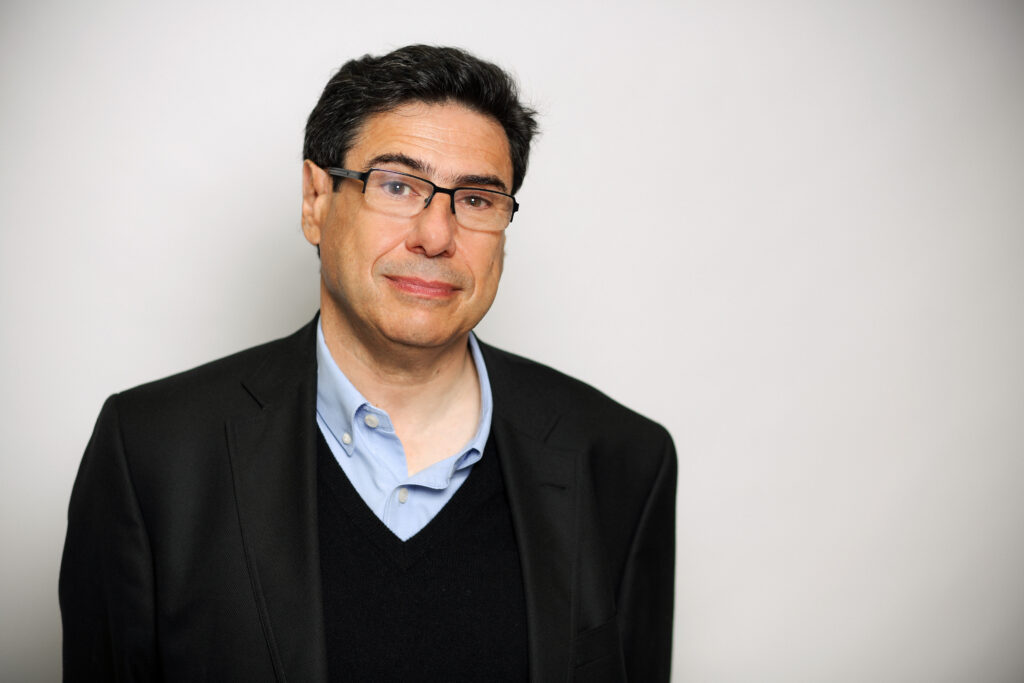
Philippe Aghion is a Professor at the Collège de France, at INSEAD, at the London School of Economics, and a fellow of the Econometric Society and of the American Academy of Arts and Sciences. His research focuses on the economics of innovation and growth. In 2025, he received the Nobel Prize in Economics.
You received the Nobel Prize in Economics this year alongside your colleagues for having formalized the Schumpeterian theory of creative destruction into an economic model. In your view, what is the most important insight from your work?
It is a useful framework for thinking about growth: I placed the firm at the heart of the process. Growth rests on the continual arrival of new firms, new talents who develop new ideas, better ways of doing things, and who expand. They must be allowed to grow. But the danger is that, once established, they may be tempted to prevent new firms from entering the market. On one hand, income derived from innovation is needed to motivate innovation; on the other hand, yesterday’s innovators are tempted to use their income to block new innovations.
Regulating the market economy means addressing this contradiction: allowing the talented to prosper, while ensuring that, once established, they do not prevent new talents from emerging.
My first idea: innovation is cumulative—each generation stands on the shoulders of giants. Second idea: it is driven by income from innovation: firms benefit from a temporary monopoly when one has a better product or a better way of producing. Third idea: creative destruction, which can overcome secular stagnation [a state of little to no economic growth].
This framework makes it possible to understand what holds certain countries back: often, it is yesterday’s innovators or imitators who prevent newcomers from entering the market. It sheds light on historical puzzles such as the take-off of growth in the nineteenth century, the middle-income trap, secular stagnation, and the relationship between growth and inequality.
When you arrived at Harvard, the dominant model was that of Robert Solow. It describes growth as a function of a country’s capital stock, its population, and a “technology” factor also known as the “residual.” How did you move from the Solow model and Schumpeterian theory to arrive at your model of creative destruction?
One derives the expression for the Solow residual: the product of the frequency of innovations and the logarithm of the size of innovations. With Peter Howitt, when we discovered this, we told ourselves: “We are on to something.”
It was late 1987, early 1988. We were neighbours in adjoining offices at MIT. I wanted to incorporate imperfect competition into growth theory. It was an idea of Schumpeter’s, but no mathematical model existed. We built a model from a blank page.
We obtained the basic model very quickly. It was then extended by us and by others: competition, unemployment, climate, secular stagnation, the middle-income trap. It became the dominant model. I have never stopped working on growth. What matters most is that many young researchers are working on it. What I always say is: the day I become obsolete, that will validate my theory.
Let us talk about Solow…
Let me say right away that Solow was a wonderful person—he was my colleague, and he was always a great supporter.
Let me tell you a story connected to Harvard. I dreamed of joining the Harvard Society of Fellows. After my oral entrance examination, Solow told me: “You did not quite understand the question.” I understood that it was over. But had I been accepted, I would probably never have met Howitt at MIT, and we would not be here discussing today.
Failure has played a very important role in my life. I failed the agrégation [the most prestigious examination for professors] in mathematics. I experienced romantic setbacks. Had I succeeded, I would never have left [France]. My failures were instrumental in my path to the Nobel Prize.
In the past, you have frequently engaged in French political discourse, supporting certain projects or criticising fiscal reforms. How do you decide that a subject warrants your public intervention? How do you reconcile research and civic engagement?
I came to economics through politics. I was a communist activist in my youth, influenced by Italian Eurocommunism. When I was in secondary school, I wanted to be close to the working class.
Yet I observed people who had apparently coherent discourses and arrived at opposite conclusions. I told myself: I need to understand economics. I studied Marx closely, Das Kapital.
I was obsessed with growth because my intuition was that it would lift people out of poverty. So now, I am no longer a communist. I am a social democrat—a social Gaullist, if you will. I believe in shared and inclusive prosperity, in meritocracy, in education, in the Republic.
That is how I came to economics: with social motivations, while also having a mathematical training. And I still hold the same values.
Poverty scandalizes me. The absence of social mobility scandalizes me: it has become considerably more difficult today for a worker’s son or a child from a modest background to rise. Some simply never get their chance. The social elevator in France has disappeared. This conviction I have kept since my youth. Social mobility is an obsession for me. I want growth, but growth that goes hand in hand with social mobility, to lift all of society upward. The communist system failed to produce it: the Soviet Union stagnated. China is no longer communist; it is state capitalism.
Research means understanding. I try to understand in order to transform. However, if the results contradict my priors, I do not alter my model on that account. I go back to it and try to understand; I conceal nothing. I move back and forth between theory and empirical data. Public debate nourishes my research, and vice versa.
What are the major differences you see between France and the United States?
In the United States, failure is valued rather than stigmatized. You are told: “Try and fail.” This is reflected in a whole range of institutions: long-term fundamental research, venture capital for startups, institutional investors for large firms. Short-term failure is tolerated because it is recognized that breakthrough innovation is impossible without experiencing failure at some point. In France, one is given the dunce’s cap and that kills innovation. It is a problem of culture and institutions.
How can the energy transition be integrated into your model?
We must move towards green innovation to reconcile growth with the fight against climate change. But firms are not spontaneously green. Those that have innovated in polluting technologies tend to continue doing so. This is path dependence.
Creative destruction helps, because new entrants do not have this problem. But we must also redirect the innovation of incumbent firms. We need both the carrot and the stick: a carbon tax and green industrial policy, subsidies for green innovation. There are environmental externalities and technological externalities. With two externalities, at least two instruments are required. Used alone, the punitive instrument produces the revolt of the gilets jaunes—raising fuel prices without offering any incentive in return.
Is Europe in decline?
Europe has declined in breakthrough innovation relative to the United States and China. I am a fighting optimist, but not in denial. We have very good researchers, excellent universities, first-rate engineers. But we have a problem with breakthrough innovation and that is what the Draghi report demonstrates. And many of these talents have left. Yet I am not pessimistic: we have democracy, a social model, culture, and soft power.
But we need a genuine single market, a financial ecosystem suited to venture capital, more securitisation without reproducing the financial crisis, a European DARPA,1 and more long-term research funding. The ERC2 funds over five years; the LabEx3 programme in France previously funded over ten years—that is good, but we need to do more.
We possess formidable strengths. But we need the institutional environment that fosters enterprise and innovation.
Let us turn to the subject of inequality. Your research has shown that innovation does not truly increase inequality in the broad sense. Can you explain that?
First, we must clarify what we are discussing. There are several measures of inequality. The first is a global measure: the Gini coefficient, which captures the deviation from perfect equality. The second is a dynamic measure—intergenerational inequality: the extent to which an individual’s income is correlated with that of their parents, that is, the degree of social mobility. The third is the share of income captured by the top one percent and the top 0.1 percent. Some focus exclusively on this last measure. For my part, my principal concern remains the Gini coefficient and social mobility.
For some, a rich person is a rich person—innovator or not—and they fail to recognize that certain policies can destroy innovation. Yet it is innovation that generates the prosperity we redistribute. One cannot distribute what one does not produce.
Second, if one examines innovation, there are several sources of income for the top percentile. The first is innovation: when one innovates, one earns income from that innovation. The second is lobbying, barriers to entry, and so forth. There are thus good and bad sources of income at the top, and I do not treat them in the same way. This is where the Schumpeterian model is particularly illuminating: it draws this distinction. For some, a rich person is a rich person—innovator or not—and they fail to recognize that certain policies can destroy innovation. Yet it is innovation that generates the prosperity we redistribute. One cannot distribute what one does not produce.
It does not trouble me that individuals become wealthy through innovation. But I want to ensure that they do not use their wealth to prevent newcomers from entering. I address this through fiscal policy, but also—and above all—through competition policy and the regulation of political campaign financing. In the United States, the Supreme Court has allowed the wealthiest to finance political campaigns without any limit. The result speaks for itself: Mr Musk finances, and he gains access to the Oval Office. That is a serious problem. This is how I view inequality, and how my approach differs from those who wish to treat all wealthy individuals identically, regardless of the source of their wealth.
On precisely this link between inequality and innovation: the United States is more unequal than Europe in the general sense. Do you not think that inequality enables the absolute concentration of resources that fosters innovation?
That is not the right way to reason. One should not assert that inequality is good or bad for growth. I examine policies, and I observe what those policies produce in terms of growth on the one hand and equality on the other. I cannot claim that inequality is good for growth as a general matter. What I maintain is that innovation and social inclusion can be fully reconciled.
For example, I have shown in chapter five of my book that where there is more innovation, there are indeed more inequalities at the top.4 But one also observes more social mobility, and therefore no increase in overall inequality. In a paper published in the Review of Economic Studies, we also found that in the most innovative regions of the United States, there are greater inequalities at the top linked to innovation, but also greater social mobility.5 When one examines the effect on overall inequality, no increase is found.
What policies make it possible to be both more innovative and more inclusive?
Certain policies make it possible to be both more innovative and more inclusive. Let me cite three.
First, competition. More competition means more new entrants, therefore more social mobility and less overall inequality.
Second, education. With a good educational system, as in Asian countries, there are fewer “lost Einsteins” or “lost Marie Curies,” to borrow Jean Tirole’s expression. This produces both more innovation and more inclusivity.
Third, Danish flexibility. When one loses one’s job—and creative destruction implies that one can lose one’s job—in Denmark, there is a system that guarantees 90 percent of one’s salary for two years, while the state helps one find new employment and provides retraining. These three policies make a country both more innovative and more inclusive. The United States, by contrast, is highly innovative but has a deficient social model: it has neither flexibility nor an inclusive educational system.
Let us turn to the tech overlords. Innovation in the United States appears structured around Silicon Valley and its leading figures. What is the problem?
The fundamental problem is that the dominant players were allowed to impose themselves during the information technology revolution. They are the ones who control the cloud—the Big Tech firms. There was no competition policy that adapted sufficiently to this revolution. They were able to engage in mergers and acquisitions without limit, grow to an enormous size, and inhibit the entry of new players. Unfortunately, in the AI value chain, the same Big Tech firms are found upstream. This poses a major problem.
AI holds enormous growth potential because it facilitates the production of goods, services, and ideas. It represents potential for growth and the creation of new jobs. But the domination of Big Tech over this sector is untenable. Competition policy ought to be adapted. Yet the problem in the United States is that under Mr Trump, more than ever, crony capitalism prevails.
One final, more personal question. You have received your Nobel Prize. How has this experience changed your life?
First, I am a man prone to verbal missteps and I must now be careful with my words, as they end up in the press the very next day. For example, I stated that certain members of parliament were not up to standard, and immediately, one of them demanded that my Nobel Prize be taxed. One’s words carry more weight when one is a Nobel laureate; they must therefore be measured with greater care.
And then there is a great danger that I call “nobelitis”: one stops doing research, one accepts invitations to speak here and there, and one’s discourse ends up going round in circles. This must be avoided at all costs. To do so, one must continue research as much as possible, just as before the Nobel. In reality, the Nobel can stimulate research and make it easier to obtain funding. One must approach the Nobel as one approaches innovation: it is a tremendous opportunity to do more research, not a reason to do less. I have research projects, and nothing will make me abandon them.
Interview conducted on December 26, 2026 by Feodora Douplitzky-Lunati (Harvard College, ’26) and Luc Hillion (Master in Public Policy, Harvard Kennedy School, ’26).
1. Defense Advanced Research Projects Agency (DARPA) is a U.S. Department of Defense agency, established in 1958, responsible for developing breakthrough technologies for national security.
2. European Research Council.
3. The laboratories of excellence (LabEx) aim to foster the emergence of ambitious scientific projects that are visible on an international scale, carried out by laboratories or groups of laboratories in all territories and in all disciplines, including in the humanities and social sciences.
4. Philippe Aghion, Céline Antonin, and Simon Bunel, The Power of Creative Destruction (Cambridge, MA: Harvard University Press, 2021).
5. Philippe Aghion, Ufuk Akcigit, Antonin Bergeaud, Richard Blundell, and David Hémous, “Innovation and Top Income Inequality,” Review of Economic Studies 86, no. 1 (2019): 1–45.