
Giulia Viacava is an undergraduate student at Harvard College and a member of the Harvard Women’s Swimming and Diving Team.
My father pulls my two large suitcases out of the trunk. I look at him, a broad smile on my face, my eyes filled with tears. This time, it’s real: I’m leaving to study in the United States.
A year earlier, this idea had seemed almost unreal. And yet, here I am, standing in front of the campus I had dreamed of: Harvard. I had always wanted to leave, to change my surroundings, to see what lay beyond my small town where every day seemed to blend into the next.
The American Dream had always intrigued me, so I looked into the recruitment process for student-athletes. What followed were countless FaceTime and Zoom calls—and I mean countless, as in several times a week with different universities—as well as many evenings spent practicing my American accent to sound more convincing and rehearsing every possible question to avoid ending up with “uh, um, so, um” and to try to seem at least somewhat credible (which is not easy when your vocabulary is limited).
The list of universities grew quickly, with prestigious names that surprised me, like Harvard, Princeton, the University of Michigan, LSU, and more. After months of waiting, the impossible happened: “We want to offer you a spot on our team,” the Harvard Swimming and Diving coach told me. For a second, it didn’t feel real. Then I snapped back to reality and accepted on the spot.
Since the departure was still more than a year away, I had tucked this news into a corner of my mind without really thinking about it… until that moment, surrounded by all my suitcases.
During the entire flight, I dreaded the moment I would arrive on campus and meet my teammates and roommates. I imagined every possible scenario—heavily influenced by American movies, I must admit.
As soon as I set foot on campus, I was greeted with a booming, “Welcome, Class of 2028!” “So this is where I’ll live for the next four years,” I thought immediately. I picked up the key to my dorm and was so overjoyed to finally be on the campus I had dreamed of that I jumped for joy when I saw my room. It was about the size of my living room back home… except that five of us would be living in it.
My freshman dorm had three bedrooms: two doubles and one single, with a common area and a bathroom included. Pure luxury! I went to the dining hall for the first time and stood there, mouth open, in awe of its beauty. I think it was designed to distract us from the food! I often joke about this: everyone has the preconceived notion that the food is terrible and that it would be hard to adjust. The week before I left, my mother—who is Italian—had prepared nothing but pasta dishes for me. She wasn’t sure they even had pasta in the United States (spoiler: they do). Sure, it’s not as good as my mom’s, but honestly, between some dining halls in France and the ones in the U.S., there isn’t a huge difference in taste. And if you don’t like the dining hall food, there are kitchens in the basements of all the dorms, so you can cook whatever you want.
I was the first to arrive in my dorm, so I watched my roommates walk in one by one through the door. I remember that, on our very first night together, the five of us talked for hours, sharing stories about our lives and getting to know each other. I had never been so focused in my life, trying to understand every word they said, even though they spoke very quickly. They’re all American! Then it was my turn to speak. I said I was from Monaco, and one of my roommates confidently replied, “Oh, so it’s near Greece, right?” I burst out laughing. After that conversation, I immediately knew they would become my best friends. After just a few days, we knew almost everything about each other, as if we had always known one another.
Harvard has a unique system: the summer before freshman year, we fill out a form indicating our sleep schedules, habits (whether we’re organized, quiet, etc.), and priorities. Students with compatible profiles are then grouped into the same room. I will never thank Harvard enough for pairing me with these incredible people. In fact, I still live with them in my sophomore year, and I’ve even visited them at their homes during Thanksgiving and before Christmas! Before arriving at Harvard, I was very afraid of being alone or not making friends because I was a foreigner and my English wasn’t perfect. But once again, this fear was shattered in a single evening. On the contrary, I quickly discovered that Americans love meeting international students. They often find accents charming and are very curious to learn more about our cultures and countries. Far from feeling lonely or isolated, I felt welcomed with incredible kindness from the very first days.
A few days before the start of training, I met the entire team at a picnic. I remember being stressed about learning thirty new names; I had even studied the roster before going. Immediately, I felt incredibly welcomed, almost like I was part of a family. It was very different from what I had experienced in my club back home. I was more or less friends with everyone, but since swimming is mostly an individual sport, I had never really felt this sense of inclusion and family.
This feeling was also evident during competitions. They are nothing like the ones I was used to in France. In France, competitions were almost silent for me. I would warm up alone, locked in my own bubble. I would swim my race, exchange a few words with my coach, and then disappear for twenty minutes in the recovery pool. I would spend most of the time looking at my phone or talking to a few teammates, without really paying attention to what was happening in the pool, unless there was a particularly interesting race or friends competing.
Here, it’s the complete opposite. We have a team meeting before every competition, and we do a team cheer together. The team spirit is louder than our speaker, which shakes the pool windows with Sexyy Red’s “Get It Sexyy” blasting at full volume. The energy level and atmosphere are truly unmatched. We enjoy swimming for something bigger than ourselves, which wasn’t really the case back home. We cheer on all our teammates and never stay on our phones. It’s amazing to swim with twenty people cheering you on. I would say this is one of the most striking differences between college sports in the U.S. and club sports in France, along with the fact that most competitions last only a few hours, rather than several days as in France.
The National Collegiate Athletic Association (NCAA) considers college sports as a leisure activity, so certain rules apply, such as a mandatory week of rest after the end of the university season. I think this notion of amateurism also allows us to see sports from a different perspective, perhaps a more relaxed one, where we remember why we chose to practice this sport and why we love it so much.
We enjoy swimming for something bigger than ourselves, which wasn’t really the case back home.
Those are the thoughts I try to hold onto on Monday mornings when my alarm goes off at 5:30 a.m.
I used to think waking up at 6:30 a.m. was already an achievement in high school to swim from 7 to 9 a.m., but I wasn’t ready for American mornings. In reality, yes, it’s sometimes difficult, but you get used to it. And it’s always funny to see the reaction of non-athletes when you tell them you train morning and night almost every day. The perception of athletes is another aspect of the U.S. that I particularly appreciate. Here, sports are more valued, especially at the university level, and most students follow the results of the various campus teams. This would never happen back home. Students from my high school following swimming? Never (unless they were swimmers themselves, and even then…). This integration of sports into academic and social structures aligns with the image of the American Dream we see in movies, especially during football games. “Game Day” is a sacred day for students: they all gather at the stadium, proudly sing their university’s chants, eat hot dogs, and have a great time together. And you don’t need to know much about American football—you just need to hate the opposing team!
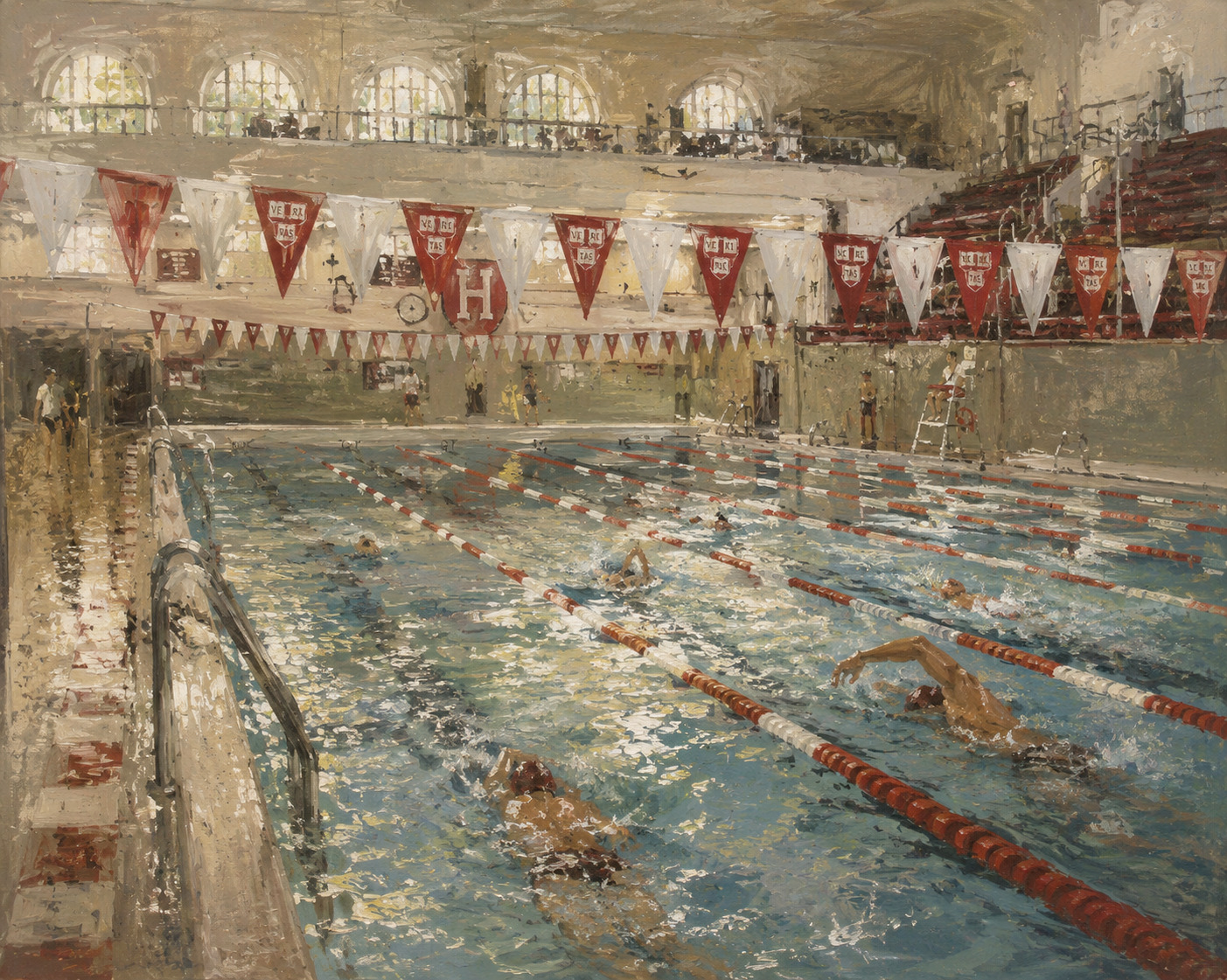
Even though we are considered “amateurs” by the NCAA, the athletic facilities and resources at American universities tell a different story. The pools at Harvard are so impressive that even some national training centers would struggle to compete. We have an Olympic-sized pool that can be converted into a 25-yard, eight-lane pool, with a diving well, as well as another 25-yard, six-lane pool. If needed, there’s also another pool closer to the classrooms, primarily for public or student use, but still a 25-yard, six-lane pool. As for the staff, there’s everything you could possibly imagine: physical therapists, nutritionists, mental coaches, strength trainers, doctors, coaches, assistants… There’s truly someone for everything.
This abundance of support extends to academics as well. During our first year, we are assigned “first-year advisors” and “advising fellows” (older students) who help us navigate all the resources Harvard has to offer and choose courses that might interest us. In our sophomore year, after declaring our “concentration” (our major), we are assigned more specialized advisors who help us find courses aligned with our academic goals, secure internships, or direct us toward other resources.
Another major advantage: the professors. What surprised me the most here is their accessibility. Even in classes with up to 500 students, it’s possible to have calm discussions with them or even grab coffee together. For homework, there are all kinds of tutoring options: one-on-one, group sessions, led by students or professors—all provided by the university. I’m not suggesting that everything is easy and that everyone gets good grades without effort. But the system is designed so that students who genuinely want to learn, ask questions, and put in the work are rewarded.
One of the things I’m most grateful for is the number of opportunities this country offers. Last summer, I returned to France to spend time with my family and wanted to find an internship, as most of my Harvard classmates were doing. I sent emails everywhere, but few people responded, and most of the replies were negative. I only managed to secure two weeks of shadowing in a hospital (simply because I knew someone), but it wasn’t even what I had wanted to do in the first place. I mostly did it to avoid being bored at home. I managed to squeeze in a quick visit to a lab, but I soon realized that there was more equipment in our Harvard classroom labs than in that hospital lab… Once again, the resources were incomparable. After this experience, I started looking around Cambridge and Boston for a lab that truly interested me. Eventually, I found one that was exactly what I was looking for, and I’ve been working there several days a week ever since, learning so much. There are so many more resources available for young people who want to learn, and I am truly grateful for that. America is also incredibly attractive from a professional perspective: for the same job, you can earn more than twice as much as in France, even as a student.
My daily routine has also changed dramatically. Here, I’m always busy. For example, my Mondays look like this: I wake up at 5:30 a.m. to take the university bus at 5:45, which takes me to the pool. At 6:15 a.m., practice begins (an endurance workout, one of the toughest of the week). At 8:15 a.m., I get out of the water and rush to catch the bus to my 9 a.m. math class. At 10:15 a.m., I leave the classroom, cross the Yard, and take the M2, the free bus that takes me to the lab where I work. I eat lunch between experiments, then leave the lab to attend my 1:30 p.m. computer science class, before heading back to the pool for a second practice, followed by a weightlifting session. After the second workout, I go to my last class of the day: Tissue Engineering, which ends at 5 p.m. Then I do my homework for about an hour before dinner and head to my student job. I gotta fund that post-exam shopping spree, since the lab doesn’t pay me yet! Once I’m done with work, I finish my homework, often at the Cabot Café with friends (yes, my dorm, Cabot House, has its own café), and finally go to bed around 11 p.m.
You might think I have no social life, but I assure you I always find time to spend with my favorite people. There are so many activities on campus: painting or pottery classes, shopping trips to Boston, or simply relaxing at a café. And of course, there are Saturday night adventures, like “mixers”—parties organized between different sports teams to help students get to know other athletes. You never get bored!
Leaving has opened my eyes to so many things. On one hand, when I returned home, I appreciated the sea, the warmth, and the fact that everything is close by, that you can walk everywhere without needing to take the subway or the bus. On the other hand, I realized there were so many more things to do here than back home, where everything had started to feel redundant: the same restaurants, the same places, the same faces. I now realize that maybe it wasn’t the place where I could grow the way I wanted to. Leaving also made me more independent and taught me to fend for myself (which isn’t easy when your dad has been driving you to school and practice every morning for as long as you can remember). I finally feel like I can do whatever I want. The only limits are the ones I set for myself. My future is ahead of me, and I can shape it however I wish. Sure, it’s sometimes overwhelming to think about, but it’s also incredibly exciting to see all these new doors opening. America has also made me far more open-minded, thanks to the different cultures and opinions that coexist and interact (most of the time, at least at Harvard). I’ve also discovered new aspects of myself: a new way of seeing things, more confidence, and a better understanding of what I’m truly passionate about.
Sometimes, I think back to that moment on the sidewalk, with my two big suitcases and my dad by my side. At that moment, I had no idea how much this decision would transform my life. Today, I know that leaving was one of the best decisions I’ve ever made, and I will always be grateful for this opportunity.
Published May 11, 2026