
Marine Gapihan — Master in Urban Planning, MIT, Class of 2026.
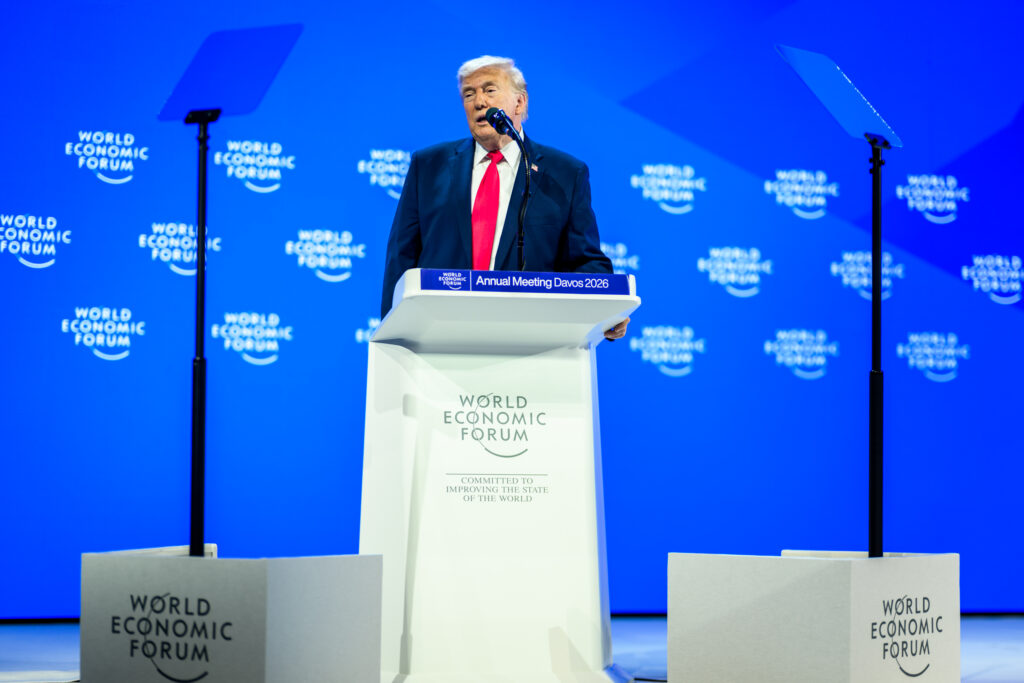
It is a difficult moment for the Green New Deal movement, both at home and abroad. In the global energy transition, the West is no longer a unified bloc. In January 2026 in Davos, the U.S. president dismissed what he called the “Green New Scam” as “perhaps the greatest hoax in history,” while advocating for expanded fossil fuel production.12 Invoking the historic bonds between the United States and Europe, he argued that energy should anchor a strong and united West. But the vision he outlined was not one of shared decarbonization. It was one centered on fossil fuels. In a war of tariffs, Washington tied a broader trade agreement to a European commitment to purchase $750 billion in U.S. liquefied natural gas, oil, and nuclear energy products by 2028, effectively inserting fossil fuel procurement into the heart of transatlantic trade negotiations.13 More recently, the United States threatened to withdraw from the International Energy Agency, an institution it helped build and still funds at roughly 14 percent. The list could go on…
There is no doubt that we are observing a shift from a transatlantic climate alliance built on shared ambitions to one shaped by transactional energy politics.
The divergence raises fundamental questions: where are the United States and European Union heading? Can the European Union define its own economic and industrial model, one built around carbon pricing, green manufacturing, and energy sovereignty?
The European Union is not retreating from its green transition;, it is reframing it. Faced with geopolitical pressure from Washington, Brussels has shifted the narrative from climate idealism to energy security and affordability.14 The green transition is no longer presented primarily as a moral imperative to “save the planet,” but as a strategy for sovereignty, industrial competitiveness, and price stability; a framing not unlike the one used by legislators in states such as New York, New Jersey, or Virginia. At the ministerial gathering of the International Energy Agency this past February, European officials downplayed explicit climate messaging, choosing instead to highlight the energy security advantages of renewable power. And under pressure from member states and from a lobbying coalition of large multinationals, predominantly U.S.-based, the EU scaled back on key elements of its Omnibus I framework. The EU is seeking for more flexible and business-friendly measures to reduce its greenhouse gas emissions.15
There is no doubt that we are observing a shift from a transatlantic climate alliance built on shared ambitions to one shaped by transactional energy politics.
And with or without the U.S., Europe is moving forward. Weakening the Green Deal would not simply slow emissions reductions; it would erode Europe’s ability to position itself as a credible geoeconomic and geopolitical actor in the new global order.16 Roland Lescure, France’s Minister of the Economy, said it himself: “France and Europe’s strategic and structural answer is electrification. We of course still have gas needs, notably for the industrial sector, and I’m very happy the U.S. can meet that need, but objectively the long-term goal is to exit a dependence on imported fossil energy that is still too great.”17 The numbers confirm it. In 2025, wind and solar power surpassed fossil fuels in the EU electricity mix for the first time on an annual basis, generating over 30% of power compared to 29% from coal and gas. A huge win for the old continent. Investment trends tell a similar story: U.S. investment in renewables was down 36% in the first half of the year compared to the second half of last year, while EU-27 investment was up 63%.18
By loosening its climate relationship with the EU, the United States risks isolating itself from a clean energy future that is both an inevitable and economically rational trajectory. If Washington treats liquefied natural gas (LNG) exports and tariffs as geopolitical leverage to protect domestic fossil fuel interests, Europe will hedge and hedging increasingly means deeper commercial engagement with China.
The critical technologies underpinning Europe’s green transition are today deeply embedded in Chinese supply chains. China accounts for roughly 90 percent of global photovoltaic manufacturing capacity and dominates key segments of wind turbine, battery, and electric vehicle production. Despite the EU’s recent “Made in Europe” industrial push, which requires a share of publicly supported clean-energy technologies to be produced domestically, Europe cannot decouple overnight.19 Nor is China merely a low-cost manufacturer anymore. Decades of state-backed investment have positioned Chinese firms as technological leaders in EVs, grid equipment, robotics, and advanced manufacturing.
U.S. tariffs aimed at constraining China’s industrial expansion may instead redirect Chinese overcapacity toward Europe.20 That dynamic risks increasing the structural interdependence between Europe and Chinese clean-tech supply chains, even as Europe is trying to increase its domestic capacity. In attempting to weaken Beijing, Washington may unintentionally accelerate Europe’s economic integration with it. This is not in the United States’ strategic interest.
China is not slowing its clean-energy expansion. The clean energy sector drove more than a third of China’s GDP growth in 2025.21 It is building renewables, batteries, EVs, grid infrastructure, and nuclear capacity at scale, while simultaneously dominating upstream mineral processing and midstream manufacturing. If the U.S. distances itself from Europe on climate and industrial coordination, it does not weaken China. It isolates itself.
It is in the United States’ interests to build a durable EU-U.S. climate partnership, focused on joint value and standard-setting, coordinated industrial policy, supply-chain diversification, shared innovation funding, and aligned carbon pricing frameworks such as the Carbon Border Adjustment Mechanism (CBAM) and the former Inflation Reduction Act’s clean-energy tax incentives. Long-term regulatory predictability, not episodic tariff escalation, is what will attract investments and reduce dependence on competitive supply chains.
One area where cooperation remains tangible is nuclear energy. In February, U.S. officials announced concrete steps toward deploying advanced American nuclear technologies in Central Europe, aligning energy security objectives with decarbonization goals.22 It demonstrates what strategic energy leadership rather than transactional leverage can look like.
The United States can treat energy as a bargaining chip. Or it can treat it as a platform for leadership. Europe is moving forward with its green transition either way. The question is whether the United States wants to shape that future alongside its closest historical ally.
1. World Economic Forum, “Davos 2026: Special Address by Donald J. Trump, President of the United States of America,” World Economic Forum, January 21, 2026.
2. Saptarshi Chakraborty, “Trump’s $750 Billion EU Energy Deal Is Built on an Illusion,” LSE U.S. Centre (USAPP Blog), October 14, 2025.
3. Politico Europe, “Europe Swaps Climate Rhetoric for Energy Security Talk to Defuse MAGA Green Backlash,” Politico, February 2026.
4. Biagio Moro, Lorenzo Silvestri Martini, and Giovanni D’Amico, “The Green Deal under Attack: U.S. Influence and the Struggle for European Autonomy,” ECCO Climate, January 30, 2026.
5. World Economic Forum, “Davos 2026: Special Address by Mark Carney, Prime Minister of Canada,” World Economic Forum, January 20, 2026.
6. Francesca Crellin and Andres Hernandez, “US Energy Secretary Wright Pressures IEA to Quit Net Zero Agenda,” Reuters, February 19, 2026.
7. Vandana Gombar, “Record Renewable Energy Investment in 2025: Three Things to Know,” BloombergNEF, September 10, 2025.
8. Moderndiplomacy.eu, “Inside the EU’s Draft ‘Made in Europe’ Law: Key Points Explained,” Modern Diplomacy, February 17, 2026.
9. Maya Lameche, “Power, Policy, and Partnerships: EU-US Energy Security in a Changing Geopolitical Landscape,” Carbon Free Europe, February 11, 2025.
10. Lauri Myllyvirta and Boris Schaepe, “Analysis: Clean Energy Drove More Than a Third of China’s GDP Growth in 2025,” Carbon Brief, February 5, 2026.
11. U.S. Department of State, “Secretary Rubio Advances National Security through Civil Nuclear Deals in Central Europe,” U.S. Department of State, February 16, 2026.