
Virginie Greene is a retired Harvard professor of French and specialist in medieval literature whose work spans philosophy, Proust, and literary encounters across history.
All Francophones are homeless. There is no word in French that captures the English home—its comfort, its coziness, its fortress-like security. For thirty-six years, I had a home in the United States, but I was never at home. All those years, I migrated like a wild goose, back and forth between my home and chez moi, following the rhythm of the academic year.
Chez moi is Saint-Dié, a town of 20,000 in the Vosges department, in the region now called “Grand Est.” In the summer of 2023, my annual migration came to an end. I returned chez moi to spend my retirement. I will visit the United States again, but I no longer have a home there.
I came back chez moi after living for a long time in a country, a culture, an environment that championed progress, exploration, growth, movement, adventure—all while promising security and the comfort of home for everyone. A promise that increasingly resembles a dream, or a nightmare. For all those years, I felt at home in the academic version of that culture. Yet there was always this other place inside me, one I could never quite explain to my American parents, friends, or colleagues. When I returned chez moi, I didn’t go to Paris or Provence, but to Déodatie—the small region around Saint-Dié. Dié is short for Deodatus, an 8th-century hermit monk, tamer of wolves and feller of firs. To non-Déodatians, Déodatie sounds like the Shire of Bilbo Baggins. Perhaps, all those American years, I was a hobbit in disguise?
Returning home seems the opposite of travel, even though one of the great travelers of legend had no other goal than to return to his own land. I went from Cambridge, Massachusetts, to Saint-Dié, Vosges, via San Francisco, Chicago, and Paris—not because the gods opposed my return, but to say goodbye to people and places. The real journey began after this brief odyssey. It was no longer about crossing continents, but about scale. I had to recompose my mental maps. What is a world whose center is Saint-Dié? It is a concentric world, measured first by my own footsteps.
For thirty-six years, I had a home in the United States, but I was never at home.
Starting from chez moi on foot, I am one minute from the market square, two minutes from the post office, five minutes from the town hall, the library, and the cathedral, ten minutes from a supermarket, and fifteen minutes from the train station. Saint-Dié is not a pretty town. Much of it was destroyed in November 1944 and rebuilt in the 1950s. It is a composite place, shaped by wars and modernities since the Middle Ages. It is a cosmopolitan town whose metallurgy and textile industries once drew Italians, Poles, Portuguese, Algerians, Turks, and Senegalese. Today, the town attracts few newcomers.
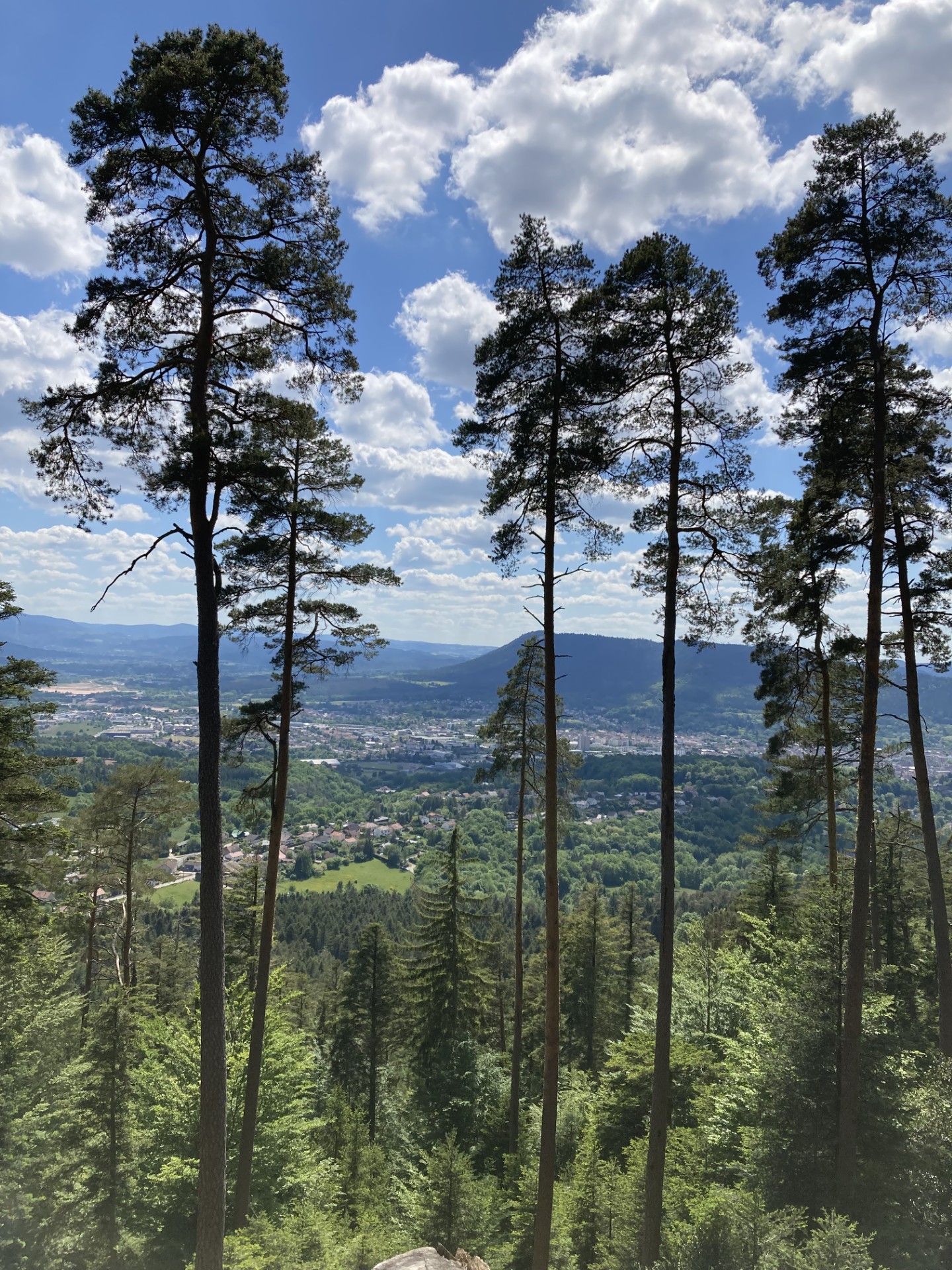
The second circle is a valley enclosed by four small wooded massifs: the Kemberg and the Madeleine on the left bank of the Meurthe, the Ormont and the Bure on the right. Twenty to thirty minutes on foot from chez moi, I find myself in a forest long exploited by humans, crisscrossed by trails, logging roads, and mountain bike paths. Fir, beech, and pine still dominate here. You can gather mushrooms and blueberries. The wood grouse has vanished. Wind turbines have appeared. The bedrock is pink sandstone, visible as sand on the paths, scree on the slopes, and bare stacks on the summits. From these heights, the view is panoramic but unassuming: a small river, a small town, small commercial zones, small farms, small gravel pits, with the rounded mass of the High Vosges in the background to the south and east.
The third circle requires a car if you want to explore it in less than a day. This is Déodatie and its outskirts: valleys of the Meurthe, Moselle, and Rhine tributaries, reached by mountain passes. Towns, villages, hamlets, old textile mills and paper factories, war memorials—wars and deindustrialization have left their mark on this green countryside. After two years, I am still discovering places and sites: a 16th-century town hall in a town once notorious as a hellhole; a Mennonite valley; boundary stones marking the territories of Gaulish tribes; museums, bookshops, festivals, gardens… all against a backdrop of hardship.
The fourth circle is regional. By road or rail, you can reach the mountainous Vosges to the north and south, the Vôge plain to the west, Alsace and Lorraine to the east. I will not have enough time left in my life to visit everything from Mulhouse to Metz, Strasbourg to Neufchâteau, Nancy to Belfort. I love returning to places I’ve already been, to rediscover sensations and decipher the passage of time. And I love keeping unknown places in reserve, to return to later. I have still never been to Toul, Luxeuil, Obernai, and many others.
Beyond this circle lie nearby European destinations, which require more planning, and distant ones, which I have not yet found the time to consider. Germany, Luxembourg, Belgium, Switzerland, and Italy are accessible for short trips. Saint-Dié–Antwerp, Saint-Dié–Coblenz, Saint-Dié–Solingen, Saint-Dié–Biella: these are routes I would not recommend to you, as they would make no sense to you, though they do to me. These destinations have enriched my sense of chez moi by situating it within a broader space and a longer history.
I was able to connect chez moi to the European space and its Lotharingian history by bringing back from another continent the ability to situate myself within a vast territory. My American mental map was not made of concentric circles measured in hours of walking, train rides, or car trips, but of projections into incommensurable beyonds. I grew up in the United States. Chez moi, I have returned to a human scale.
Published April 13, 2026